Is Ford 9N worth it in 2026 — and is it worth buying over the more common Ford 8N? Yes — for collectors, hobby farmers, and owners needing a simple, reliable utility tractor. While the Ford 8N is generally the more capable working machine, the 9N offers unmatched historical significance, straightforward mechanics, and affordable ownership for the right buyer. So is the Ford 9N worth it for your situation? Read on. After inspecting many classic Fords over the years, the biggest issues we consistently encounter on 9N tractors are worn front axle pivot pins, neglected hydraulic systems, and tired 6-volt electrical components — not catastrophic engine failures. The fundamentals of these machines hold up remarkably well when maintained.
👉 Check current Ford 9N listings — see available stock and pricing →
Written by: Farmers Equipment editorial team — specialising in classic Ford tractors from the N-Series through the Thousand Series.
Buy the Ford 9N if you:
✅ Want the first Ford tractor — historical significance matters to you
✅ Need light utility work on a small property or hobby farm
✅ Are a collector who values original unrestored examples
✅ Have a budget of $2,000–$3,500 for a good working example
❌ Don’t buy it if you want the most practical working tractor — the 8N is more capable
❌ Don’t buy it if parts availability is a priority — the 8N has a broader supply base
Ford 9N Pros and Cons
| ✅ Pros | ⚠️ Cons |
|---|---|
| Historical significance — first Ford tractor with Ferguson hitch | 3-speed transmission — less flexible than 8N’s 4-speed |
| Simpler mechanically than the 8N | Slightly lower HP (~23–26) than Ford 8N (~25–28) |
| Ferguson three-point hitch — wide implement compatibility | Narrower parts availability than Ford 8N |
| Collector appeal — first year examples particularly valued | 6-volt electrical system — harder to source batteries |
| Accessible used pricing for working examples | No position control (draft control only) |
| Strong community of 9N enthusiasts and restorers | Front axle pivot pin wear — known weak point on high-hour examples |
Ford 9N vs Ford 8N — Quick Comparison
| Feature | Ford 9N | Ford 8N | Winner |
|---|---|---|---|
| Production years | 1939–1942 | 1947–1952 | — |
| Units produced | ~99,000 | ~524,000 | 8N (more parts) |
| HP | ~23–26 | ~25–28 | 8N (slightly more) |
| Transmission | 3-speed | 4-speed | 8N (more flexible) |
| Hitch control | Draft control only | Draft + position control | 8N (more versatile) |
| Parts availability | Good | Excellent | 8N |
| Collector value | Higher (first model) | Lower | 9N |
| Typical used price | $2,000–$3,500 | $2,500–$4,500 | 9N (lower entry) |
| Historical significance | First Ford tractor | Most produced | 9N |
Bottom line: for a working tractor, buy the 8N. For a collector piece or the historical significance of the first model, the 9N earns its premium.
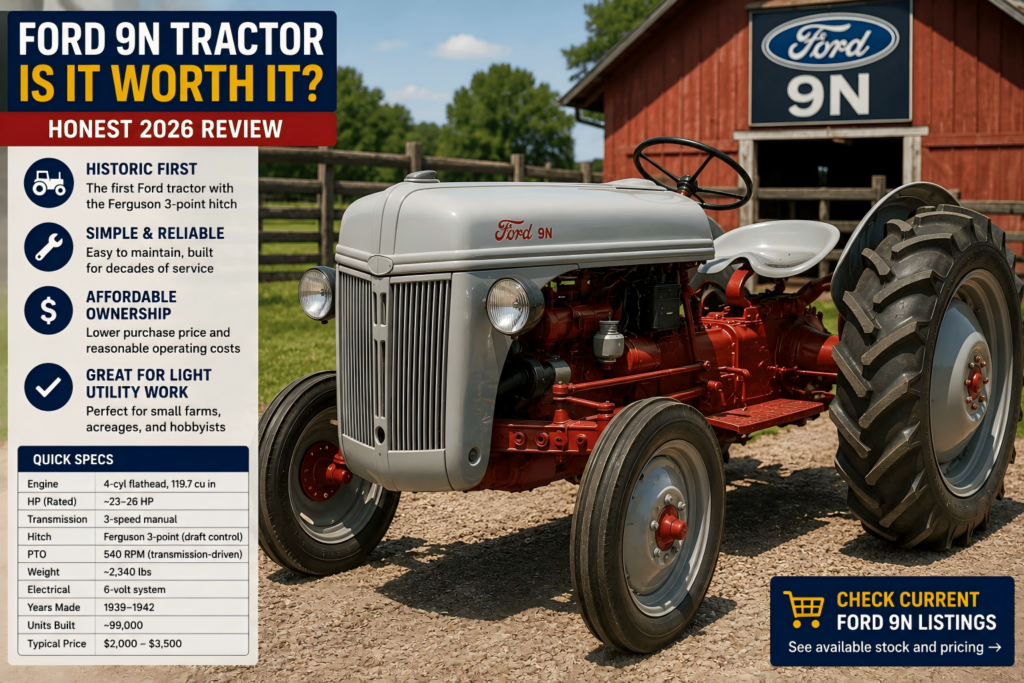
Ford 9N Quick Specs
| Spec | Detail |
|---|---|
| Production years | 1939–1942 |
| Total produced | ~99,000 units |
| Engine | 4-cylinder flathead, 119.7 cu in |
| HP (rated) | ~23–26 HP at the drawbar |
| Transmission | 3-speed manual |
| Hitch | Ferguson three-point, Category 1 — draft control |
| Hydraulic system | Ferguson system (non-live — stops when clutch depressed) |
| PTO | Transmission-driven 540 RPM (not live PTO) |
| Electrical | 6-volt |
| Weight | ~2,340 lbs |
| Typical used price | $2,000–$3,500 in good working condition |
Is Ford 9N Worth It — What It Does Well
Historical significance — the machine that changed American farming
The Ford 9N introduced the Ferguson three-point hitch system to the US market in 1939 — and that system, in its fundamental form, remains the global standard for tractor implement attachment today. Buying a 9N is buying a direct piece of agricultural history. For collectors and enthusiasts who care about that provenance, no other machine delivers it. First-year 1939 examples command a meaningful premium over later 9N production and are actively sought by serious collectors.
For the full history of what the 9N represented and why it mattered, see our Ford N-Series Tractor History guide →
Mechanical simplicity
The Ford 9N is mechanically simpler than the 8N in some respects — a 3-speed transmission has fewer components than a 4-speed, and the draft-control-only hydraulic system is straightforward to understand and maintain. For a first-time tractor owner who wants to learn mechanical maintenance on a forgiving platform, the 9N’s simplicity is genuine. The flathead engine, basic electrical system, and accessible service points make most maintenance tasks approachable with standard tools and a service manual.
Ferguson three-point hitch — wide implement compatibility
Like the 8N, the 9N’s Category 1 three-point hitch connects directly to the enormous range of implements built to the standard it established. Box blades, rotary tillers, post hole diggers, finish mowers, and disc harrows all attach and operate correctly. The draft control system automatically maintains consistent implement depth — genuinely useful for tillage and grading work.
Collector value
Clean, original, unrestored Ford 9N tractors — particularly early serial number examples from 1939 and 1940 — command a premium on the collector market that comparable working 8N machines do not. A 1939 first-year 9N in original condition with original sheet metal, correct paint, and documented history is worth meaningfully more than its working utility value suggests. For buyers approaching the 9N as a collector asset, condition authenticity matters more than mechanical performance.
Is the Ford 9N Worth It — What It Doesn’t Do Well
3-speed transmission — the main practical limitation
The Ford 9N’s 3-speed transmission gives the operator fewer options for matching engine speed to ground conditions than the 8N’s 4-speed. In practical terms this means fewer gear choices for different implements and terrain — the 8N’s additional gear makes it more flexible across different work types. For occasional light use this matters less. For regular work across varied conditions, the 3-speed limitation becomes noticeable.
No position control
The 9N has draft control only — it senses soil resistance and adjusts implement depth automatically. The 8N added position control, allowing the operator to set a fixed implement height independent of soil conditions. For operators who need to maintain consistent implement height above ground (finish mowing, snow blading) rather than consistent depth below ground, the 9N’s draft-control-only system is a real limitation.
Narrower parts availability than the 8N
With ~99,000 units produced versus ~524,000 for the 8N, parts specific to the 9N — particularly sheet metal, grille components, and some engine parts unique to the 1939–1942 run — are less commonly stocked than 8N equivalents. That said, nearly every mechanical wear component remains available in 2026 from multiple aftermarket suppliers — ignition parts, carburettors, hydraulic components, steering parts, clutch kits, and complete engine rebuild kits are all accessible through suppliers like Steiner Tractor Parts. Cosmetic items such as original-style sheet metal and grilles are also widely reproduced. For restoration-specific or original parts, the 9N requires more searching than the 8N — but it is not a machine where parts have dried up.
6-volt electrical system
The Ford 9N used a 6-volt electrical system that has never been updated from the factory. While 6-volt components still exist, battery sourcing is more limited and less convenient than 12-volt alternatives. Many 9N owners convert to 12-volt for easier maintenance — a straightforward job using widely available conversion kits, but an additional cost and modification to factor into a purchase.
Front axle pivot pin wear
The Ford 9N’s front axle pivot — the pin on which the front axle rocks to follow terrain — is a known wear point on high-hour examples. Worn pivot pins cause visible front axle movement that affects steering precision and handling. Replacement parts are available but the repair requires removing the front axle assembly. Always check for excessive front axle pivot movement during any pre-purchase inspection — grab the front axle and attempt to move it up and down. Some play is expected; significant movement warrants investigation.
Real Ownership Costs — Ford 9N
| Item | Cost | When |
|---|---|---|
| Engine oil change | $15–$25 | Every 100 hours or annually |
| 6V to 12V conversion (if needed) | $150–$300 parts | One-time — strongly recommended |
| Carburetor rebuild kit | $25–$50 | Every few years or when needed |
| Ignition tune-up (points, plugs, condenser) | $30–$60 | Every 2–3 years |
| Hydraulic lift rebuild kit | $60–$120 | When hitch drifts or lifts slowly |
| Front axle pivot pin (if worn) | $40–$80 parts + labour | As needed — inspect at purchase |
| Rear tyre replacement (pair) | $300–$600 fitted | As needed |
| Annual maintenance estimate | $100–$300 | Routine — varies with use intensity |
Ford 9N Fuel Consumption — What to Expect
| Work Type | Estimated Fuel Use | Notes |
|---|---|---|
| Idling / light work | ~0.4–0.6 gal/hr | Minimal engine load |
| Finish mowing | ~0.5–0.8 gal/hr | Light consistent load — most efficient use |
| Rotary cutting (brush) | ~0.7–1.1 gal/hr | Varies with vegetation density |
| Light tillage / box blade | ~0.8–1.2 gal/hr | Consistent engine load |
| Ploughing (2-bottom) | ~1.0–1.5 gal/hr | Near maximum engine load on a 9N |
The Ford 9N runs on regular pump gasoline. At 23–26 HP, it draws slightly less fuel than the 8N at comparable work intensity — a modest advantage on light-duty tasks where the 9N’s lower HP is sufficient.
What to Check When Buying a Ford 9N
All the standard checks from our Used Ford Tractor Inspection Checklist apply — plus these 9N-specific items:
- Front axle pivot — grab the front axle and check for excessive up-and-down movement. More than minor play indicates worn pivot pin
- Serial number verification — confirm the serial number places the machine in the correct 9N range (1–105,374). Numbers above 105,374 are Ford 2N machines. See our Ford Tractor Serial Numbers guide for full ranges
- 6-volt vs converted electrical — confirm whether the machine still runs 6-volt or has been converted to 12-volt. A converted machine is fine; a mixed-voltage machine (some 6V, some 12V components) is a problem
- Originality (for collectors) — check whether the sheet metal, grille, and paint are original or replacement. Aftermarket grilles and repro sheet metal are common and widely available — original unrestored examples command a premium
- Draft control function — engage the draft control and confirm the hitch responds to the lever. A 9N with non-functional draft control is missing its primary implement management feature
Best Jobs for a Ford 9N
- ✅ Grading driveways with a 5 ft box blade — one of the most natural 9N pairings
- ✅ Finish mowing with a 4–5 ft finish mower — well within HP range, clean results
- ✅ Post hole digging in soft to medium ground with a 6–9 inch auger
- ✅ Light brush clearing with a 4–5 ft rotary cutter on standard vegetation
- ✅ Snow removal with a rear blade — effective on farm lanes and private drives
- ✅ Moving materials with a carry-all or Category 1 rear attachment
- ✅ Light tillage in prepared soil with a 4–5 ft tiller or disc
Jobs to Avoid on a Ford 9N
- ❌ Heavy front loader work — the 9N frame is not designed for loader use and HP is insufficient for serious lifting
- ❌ Large rotary cutters above 5 ft — oversized implements in heavy material will strain the engine and hydraulics
- ❌ Round hay bale handling — requires a loader and HP the 9N cannot provide
- ❌ Heavy primary tillage in unbroken ground — at the limit of what 23–26 HP can manage; a Ford 3000 or 4000 is the more appropriate tool
- ❌ Commercial or daily professional use — the 9N is a residential and light farm machine, not a commercial workhorse
Ford 9N vs Alternatives — Which Classic Tractor Should You Buy?
| Model | HP | Best For | Price Range |
|---|---|---|---|
| Ford 9N | ~23–26 | Collectors, light use, historical interest | $2,000–$3,500 |
| Ford 8N | ~25–28 | Working tractor — best all-round N-Series | $2,500–$4,500 |
| Ferguson TO-20 | ~23 | Similar capability to 9N, live hydraulics | $2,000–$4,000 |
| Ford 3000 | ~37–47 | More power, live PTO, larger properties | $4,500–$8,000 |
| Farmall Cub | ~10 | Garden tractor and cultivating — very light use | $1,500–$3,500 |
Popular Ford 9N Upgrades
These are the modifications most commonly made by 9N owners in 2026:
- 12-volt conversion — the most common upgrade. Replaces the original 6-volt system with a 12-volt battery, alternator, and matched components. Conversion kits cost $150–$300 and significantly simplify battery sourcing and charging reliability
- Electronic ignition — replaces the points-and-condenser system with an electronic module. Improves cold-start reliability and eliminates the need for periodic points adjustment. Most kits cost $40–$80 and install in under an hour
- Sherman transmission — an auxiliary transmission that doubles the number of available gear ratios, giving the 9N’s 3-speed more flexibility across different work types. A popular upgrade for owners who find the 3-speed limiting
- LED lighting — LED headlight conversions are available for 6-volt and 12-volt systems, providing much better visibility than original incandescent bulbs
- Alternator conversion — often done alongside the 12-volt conversion; replaces the original generator with a modern alternator for more reliable charging
- Hydraulic system rebuild — not strictly an upgrade but the most impactful maintenance investment on high-hour 9Ns. A rebuilt lift cover with fresh pistons and seals restores hitch performance to like-new function
Who Should Buy the Ford 9N
- ✅ Collectors who want the first Ford tractor — historical significance is part of the appeal
- ✅ Light utility work on a small property or hobby farm where 23–26 HP is sufficient
- ✅ Buyers who want the simplest N-Series machine — 3-speed, basic hydraulics, minimal complexity
- ✅ First-time tractor owners who want to learn maintenance on a forgiving, well-documented platform
- ✅ Budget-conscious buyers — good working 9N examples typically start below comparable 8N pricing
Who Should Skip the Ford 9N
- ❌ Want the most capable N-Series working tractor — buy the Ford 8N instead
- ❌ Need position control for above-ground implement work — the 9N has draft control only
- ❌ Parts availability is a priority — the 8N has a significantly broader supply base
- ❌ Need more than 26 HP — look at the Ford 3000 or Ford 4000
- ❌ Want a machine that needs no electrical attention — the 6-volt system requires either maintenance of original components or a 12V conversion
Ford 9N Buyer Checklist
Before you buy — confirm all of these:
☑ Starts promptly from cold without excessive cranking
☑ Good oil pressure — builds quickly and holds at idle
☑ No blue exhaust smoke at operating temperature
☑ Hydraulic hitch lifts smoothly to full height and holds position
☑ PTO engages and spins freely
☑ Both brake pedals engage within similar travel
☑ Steering play within acceptable limits (no wandering)
☑ Front axle pivot — minimal up-and-down movement
☑ Oil on dipstick — clean amber to dark brown, not milky or gritty
☑ Serial number confirmed in the 9N range (1–105,374)
Verdict — Is the Ford 9N Worth It in 2026?
Is the Ford 9N worth it in 2026? Yes — for the right buyer. If you want the machine that introduced the three-point hitch to American farming, or if you are approaching a classic Ford purchase with a collector’s eye as much as a farmer’s eye, the 9N earns its recommendation. It is mechanically honest, historically significant, and capable of the light utility work most small property owners need.
If you want the most practical working tractor — buy the Ford 8N. The 4-speed transmission, position control, and broader parts base make it the stronger working machine at a comparable price. But the 9N is not a consolation prize — it is the original, and for buyers who value that, it is worth every dollar of its asking price.
👉 See current Ford 9N listings — compare available stock and pricing →
Ford 9N — Key Performance Questions Answered
How Much Horsepower Does a Ford 9N Have?
The Ford 9N produces approximately 23–26 HP at the belt, depending on engine condition and production year. The Nebraska Tractor Test figures for the 9N are:
| Measurement | Ford 9N Figure | Context |
|---|---|---|
| Belt HP (rated) | ~23–26 HP | Varies with engine condition and timing |
| Drawbar HP | ~20–23 HP | Power available at the drawbar under load |
| PTO HP (approximate) | ~20–22 HP | Transmission-driven PTO — not live |
| Engine displacement | 119.7 cu in (1.96L) | 4-cylinder flathead gasoline |
| Engine RPM (rated) | 2,000 RPM | Governor-controlled |
The 9N’s HP is slightly lower than the Ford 8N’s approximately 25–28 HP — the difference is real but not large. For the light utility tasks the 9N was designed for (2-plow implement work, light tillage, box blade grading, rotary cutting on standard vegetation), 23–26 HP is adequate. Where the limitation becomes practical is with larger implements or heavy vegetation — conditions where the 8N’s additional HP and 4-speed transmission provide meaningful advantage.
How Fast Does a Ford 9N Go?
The Ford 9N has a maximum governed speed of approximately 12–14 mph in third gear at rated engine RPM — though road travel at maximum speed is not recommended on a machine this age. Practical working speeds by gear:
| Gear | Approximate Speed | Best Use |
|---|---|---|
| 1st gear | ~2.0–2.5 mph | Heavy tillage, ploughing in tough conditions |
| 2nd gear | ~3.5–4.5 mph | Standard tillage, rotary cutting, loader work |
| 3rd gear | ~5.5–7.5 mph | Light implement work, road travel between fields |
The 3-speed transmission gives the 9N fewer options than the Ford 8N’s 4-speed (which adds a practical 5th speed option in the ~4.5 mph range particularly useful for PTO-driven implement work). Most 9N operators find 2nd gear the most used for regular field work.
How Fast Will a Ford 8N Go?
The Ford 8N has a maximum speed of approximately 12–17 mph in 4th gear at rated RPM. Practical working speeds by gear:
- 1st — ~2.0 mph (heavy tillage)
- 2nd — ~3.3 mph (standard tillage)
- 3rd — ~4.5 mph (PTO implement work, most field operations)
- 4th — ~12–17 mph (road travel — not recommended at full speed on older machines)
The 8N’s 4th gear is primarily for road transport between fields — operating implements in 4th is too fast for most work. The practical advantage over the 9N is the 3rd gear at ~4.5 mph, which gives better speed control on PTO-driven implements than the 9N’s 2nd or 3rd gear options.
How Much Can a Ford 9N Lift?
The Ford 9N’s three-point hitch has a rated lift capacity of approximately 800–1,000 lbs at the hitch — adequate for Category 1 implements in the size range the 9N was designed to handle. Practical context:
- A 5 ft box blade weighs approximately 400–600 lbs — well within capacity
- A 5 ft rotary cutter weighs approximately 500–700 lbs — within capacity
- A 5 ft tiller weighs approximately 450–650 lbs — within capacity
- Large 6–7 ft implements at the upper end of category 1 weight ranges push close to the limit — particularly with soil loading in the implement
The 9N’s hydraulic lift is the Ferguson draft control system — non-live (it stops working when the clutch is depressed). This is worth understanding in use: unlike live hydraulics on later tractors, the hitch will not hold position or respond while the clutch pedal is pressed.
What Is the Ford 9N Known For?
The Ford 9N is historically significant for several specific contributions to agricultural mechanisation that outlasted the machine itself:
- Introducing the Ferguson three-point hitch to the US market (1939) — the most important. The three-point hitch system, developed by Harry Ferguson and licensed to Ford in the famous “handshake agreement,” became the global standard for tractor implement attachment. Category 1 three-point hitches on tractors built today are direct descendants of what the 9N introduced in 1939
- Democratising tractor ownership — priced at $585 in 1939, the 9N was positioned to replace horses on small and medium farms that could not afford larger machines. It succeeded: nearly 100,000 were produced before wartime material restrictions halted production
- Hydraulic implement control — the Ferguson system’s hydraulic draft control automatically maintained consistent implement depth based on soil resistance — a genuinely novel capability in 1939 that made implements easier to operate and more consistent in field conditions
- The handshake agreement between Ford and Ferguson — the business arrangement under which the 9N was produced — a verbal agreement between Henry Ford and Harry Ferguson with no formal contract — became famous when it collapsed in 1947, leading to the Ferguson lawsuit and ultimately Ford developing the 8N independently. The dispute over the handshake agreement is one of the most frequently cited business stories in agricultural history
What Is a 1940 Ford 9N Worth?
A 1940 Ford 9N (serial numbers approximately 9N-12,603 through 9N-42,957) in various conditions in 2026:
| Condition | Price Range | Notes |
|---|---|---|
| Non-running / parts only | $400–$1,000 | Engine seized, missing components, or significant structural issues |
| Running — rough | $1,000–$2,000 | Runs and drives but needs attention — worn tyres, leaks, electrical issues |
| Running — good working condition | $2,000–$3,500 | Good mechanical condition, works as expected — most market examples |
| Restored — driver quality | $3,500–$5,500 | Repainted, mechanically sound, presentable |
| Show quality restoration | $5,500–$8,000+ | Correct paint, correct decals, matching numbers, detailed documentation |
1940 examples do not command a significant premium over general 9N pricing unless they retain specific original features — particularly the aluminium hood and grille used in early production. 1939 first-year examples with original aluminium components are the most collectible and command the highest premiums. For current market comparables, TractorHouse.com lists current Ford 9N sales across the US.
What Is a Ford 8N Worth Today?
A Ford 8N in 2026 — the most widely traded classic tractor in North America:
- Non-running / parts — $500–$1,200
- Running but rough — $1,200–$2,200
- Running, good working condition — $2,500–$4,000 (most common market range)
- Restored, driver quality — $4,000–$6,500
- Show quality restoration — $7,000–$12,000+
The 8N trades at a slight premium over comparable 9N examples in working condition — reflecting its higher production volume (and thus broader parts base), more capable specification, and wider buyer demand. See our Ford 8N for sale and Ford 9N for sale.
What Is the Best Ford Tractor Ever Made?
Opinion divides by era and purpose — but three Ford models consistently appear at the top of this discussion:
| Model | Claim to “Best” | Era | Why |
|---|---|---|---|
| Ford 8N | Most produced, most available, most practical classic Ford | 1947–1952 | 524,000 units — widest parts base, best N-Series specification, most balanced working machine |
| Ford 4000 | Best classic utility tractor — real farm capability | 1965–1975 | 3-cylinder diesel, live PTO, Category 1/2 hitch, 37–47 HP. Most capable and practical of the classic Ford utility range |
| Ford 5000 | Most powerful Thousand Series | 1965–1975 | 65 HP diesel — still actively farmed. The highest-specification classic Ford most buyers can afford to operate |
The Ford 9N holds the most historically significant position — it introduced the three-point hitch that transformed agriculture. But as a working tractor, the Ford 4000 or 5000 is more capable for any real farm use. The 8N sits in the middle — the best N-Series for working, and the most iconic classic tractor name in North America. Browse our Ford tractors for sale.
Frequently Asked Questions
Is the Ford 9N a good tractor?
Yes — for light utility work on small properties and hobby farms, the Ford 9N is a capable and historically significant machine. The Ferguson three-point hitch, simple mechanics, and accessible parts make it a practical choice for buyers whose work stays within 23–26 HP. For heavier or more varied work, the Ford 8N is a more capable machine at a similar price.
How much is a Ford 9N worth in 2026?
A Ford 9N in good working condition typically lists between $2,000 and $3,500. Running examples that need work start from around $800–$1,500. Fully restored or particularly original early examples command $4,000–$6,000+. First-year 1939 examples with documented provenance command the highest premiums in the collector market.
What is the difference between a Ford 9N and Ford 8N?
The Ford 8N improved on the 9N with a 4-speed transmission (vs 3-speed), position control added alongside draft control, improved brakes, slightly more HP, and a stronger hydraulic system. The 8N also has significantly broader parts availability due to its higher production volume. For a working tractor, the 8N is more capable in almost every practical respect. For collectors, the 9N is the historically significant first model.
Can a Ford 9N handle a brush hog?
Yes — a 4–5 ft rotary cutter (brush hog) is within the 9N’s capability on standard vegetation. Heavy brush or very thick material will strain the 23–26 HP engine more noticeably than it would on an 8N or 3000. Keep the cutting speed matched to the conditions and the 9N handles light to medium brush clearing reliably.
Should I buy a Ford 9N or Ford 8N?
For a working tractor — buy the Ford 8N. Better transmission, position control, broader parts availability, and slightly more HP at a comparable price. For historical significance or collector appeal — consider the Ford 9N, particularly early serial number examples. For a full comparison see our Ford 9N vs Ford 8N guide →