A used Ford tractor inspection checklist is the single most important tool you can bring to any classic Ford purchase — and most buyers skip it entirely. The Ford 8N, 9N, 3000, 4000, and 5000 are mechanically simple and parts are widely available, but a neglected example can cost far more to restore than the asking price suggests. This guide covers every system worth inspecting, in the order you should check it, with honest guidance on what each finding means for price and safety.
Based on common service findings across classic Ford models and used market data from 2024–2026.
| Inspection Type | Time Required | What It Covers |
|---|---|---|
| Quick walk-around | 10 minutes | Oil, cold start, smoke, hitch lift, brakes, tyres, frame |
| Full inspection | 45–60 minutes | All systems — every table in this guide |
| Compression test (add-on) | 15 minutes | Engine health — confirms ring and valve condition |
| Pre-purchase mechanic inspection | 1–2 hours | Professional assessment — recommended above $2,000 |
Plan for a full inspection on any machine you are seriously considering. The 10-minute walk-around tells you whether it is worth your time — the full inspection tells you what it is actually worth.
Written by: Farmers Equipment editorial team — specialising in classic Ford tractors from the N-Series through the Thousand Series.
👉 Browse our current Ford tractor inventory →
Before You Arrive — What to Do First
Before driving to inspect any used Ford tractor, do three things:
- Ask for the serial number — every Ford tractor has one stamped on the engine block or transmission housing. Cross-reference it against the model year on TractorData.com before you go. A seller who can’t or won’t provide it is a red flag
- Ask for service records — most classic Fords won’t have dealer records, but even handwritten maintenance notes tell you how the machine was kept
- Ask when it was last run — a machine that sat for years has different risks than one that ran last week. Plan your inspection accordingly
Bring: a flashlight, a rag, a compression tester if you have one, and someone who knows engines if you don’t. A $50 pre-purchase inspection from a local mechanic is always worth it on a $3,000+ machine.
Used Ford Tractor Inspection Checklist — Complete
1. Engine — Start Here
The engine is the most expensive item to repair on any classic Ford. Inspect it cold if possible — a warm engine hides oil leaks, smoke, and starting problems.
| Check | What to Look For | Red Flag |
|---|---|---|
| Cold start | Should start within a few cranks — hard starting cold suggests carburetor, ignition, or compression issues | Won’t start cold without excessive cranking or choke manipulation |
| Exhaust smoke — cold | Brief white smoke on cold start is normal (condensation). Blue smoke = oil burning. Black smoke = rich mixture or carburetor issue | Persistent blue or black smoke after warmup |
| Oil pressure | Watch the gauge on startup — pressure should build quickly and hold | Slow pressure build or low reading at idle after warmup |
| Oil condition | Pull the dipstick — oil should be amber to dark brown. Milky = coolant contamination (head gasket). Gritty = no filter changes | Milky, grey, or gritty oil |
| Coolant condition | Should be green or orange and clean. Brown sludge = neglect. Oily surface = head gasket leak | Brown sludge, oily film, or very low coolant level |
| Engine noise | Listen at idle — light valve tick is normal. Knocking from the bottom end is not | Deep knocking or rattling at idle — rod or main bearing wear |
| Oil leaks | Shine flashlight under engine and around gaskets. Some seepage on a 60-year-old machine is normal. Heavy drips are not | Active drips from rear main seal, head gasket, or timing cover |
Most common engine issue on the Ford 8N and 9N: worn piston rings from sitting with old oil, showing up as blue exhaust smoke and oil consumption. A compression test tells you engine health quickly — readings should be consistent across all cylinders (ideally within about 10% of each other) and fall within the manufacturer’s specifications for that specific engine. The key signal is consistency: one low cylinder relative to the others indicates a ring, valve, or gasket problem regardless of the absolute number.
2. Transmission and Clutch
Classic Ford transmissions are durable but repairs are labour-intensive. Check these carefully.
| Check | What to Look For | Red Flag |
|---|---|---|
| Gear engagement | Shift through all gears — should engage cleanly without grinding | Grinding, jumping out of gear, or missing gears |
| Clutch engagement | Clutch should engage smoothly without slipping or grabbing — slip suggests worn disc | Slipping under load, grabbing abruptly, or very high pedal engagement |
| Transmission oil | Check level and condition — the Ford N-Series shares transmission and hydraulic fluid. Milky or very dirty fluid signals problems | Milky fluid, metal particles, very low level |
| Transmission leaks | Check housing seams and output shafts for drips | Active leaks at rear axle seals or transmission housing |
| 4-speed shift pattern (8N/9N) | All four gears and reverse should select without excessive force | Difficult selection, stuck gears |
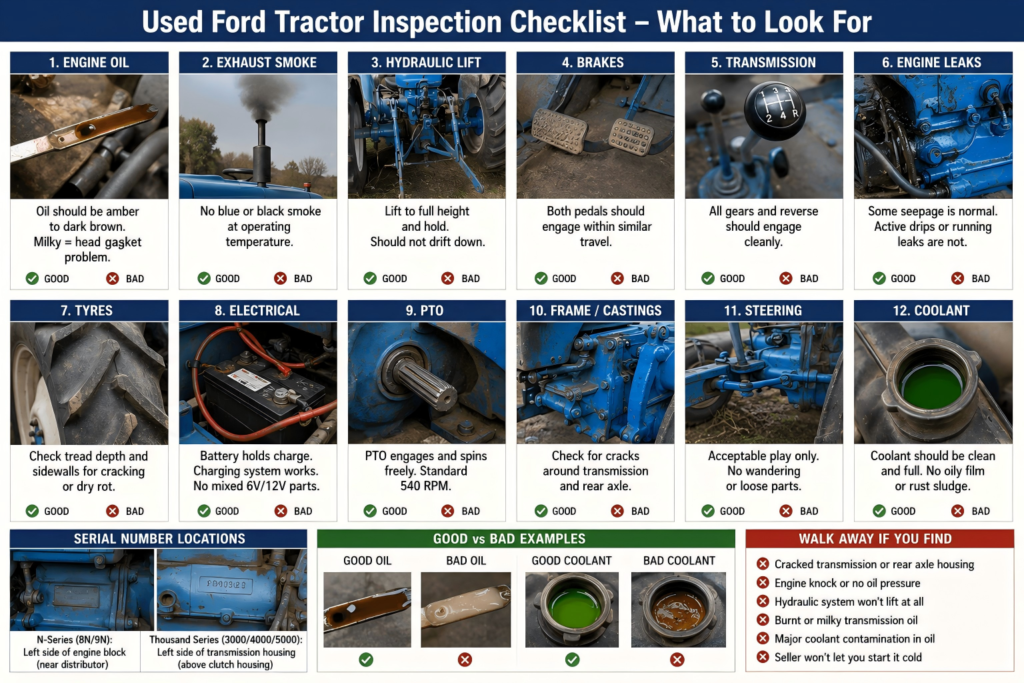
3. Hydraulic System — Critical on N-Series
The three-point hitch hydraulic system is one of the most important — and most commonly problematic — systems on classic Ford tractors, particularly the 9N and 8N. The Ford N-Series uses a live hydraulic pump integrated with the engine, not a separate system.
| Check | What to Look For | Red Flag |
|---|---|---|
| 3-point hitch lift | Raise the hitch to full height and hold — it should lift smoothly and hold position without drifting down | Slow lift, won’t lift to full height, or drifts down when held |
| Hydraulic fluid level | On N-Series, this is the same sump as the transmission. On 3000/4000/5000, check the separate hydraulic reservoir | Very low fluid, milky fluid |
| Hydraulic leaks | Check around the lift cover, hitch arms, and any external lines | Active leaks at lift cover gasket or cylinder seals |
| Draft control response (N-Series) | Move the draft control lever and confirm the hitch responds — sluggish response indicates worn pump or control valve | No response, very slow response |
Most common hydraulic issue on Ford 9N: worn lift cover pistons and control valves that cause slow lift and drift. Rebuild kits are widely available and DIY-friendly — but factor the cost into your offer if symptoms are present.
4. Brakes
Classic Ford tractors use independent left and right drum brakes — critical for safe turning and slope operation. Brake neglect is one of the most common issues on machines that sat unused.
| Check | What to Look For | Red Flag |
|---|---|---|
| Individual brake pedals | Apply each pedal separately — brakes should engage within similar pedal travel on both sides | One side significantly weaker, pedal goes to floor, or no resistance |
| Brake locking (for turns) | Confirm the pedal latch mechanism works — allows locking brakes together for road travel | Latch missing, broken, or inoperative |
| Brake adjustment | Drums may need adjustment after years of sitting — some free play is expected but excessive travel is not | Very long pedal travel before any braking effect |
| Seized brakes | On machines that sat for years, drum brakes can seize — check that wheels rotate freely when tractor is not in gear | Dragging or locked wheels |
5. Steering
| Check | What to Look For | Red Flag |
|---|---|---|
| Steering play | Some free play in classic Ford steering is normal — excessive play (more than 2–3 inches at the wheel rim) suggests worn components | Excessive play, wandering at low speed |
| Steering box condition | Check for leaks around the steering box and drag link | Leaks at steering box, loose drag link ends |
| Front axle pivot | The N-Series front axle pivots on a centre pin — check for excessive movement up and down | Significant vertical play in the front axle |
| Front wheel bearings | Grab the front wheel top and bottom and rock it — some play is acceptable, significant play is not | Noticeable in-and-out or up-and-down wheel movement |
6. Body, Sheet Metal, and Frame
| Check | What to Look For | Red Flag |
|---|---|---|
| Hood and fenders | Surface rust on 60-80 year old tractors is expected — structural rust through the metal is not | Holes, severe pitting, or non-original repairs with body filler |
| Grille and nose cone (N-Series) | Original grilles are expensive to replace — check for cracks, missing bars, or poor repairs | Broken grille or heavily patched nose casting |
| Frame cracks | Inspect around the transmission housing and rear axle casting — these are structural components | Cracks in the main castings — these are serious |
| Previous repairs | Look for evidence of welding on the frame or castings — professional repairs are acceptable, amateur welding is concerning | Poorly executed welds on structural castings |
7. Tyres and Wheels
| Check | What to Look For | Red Flag |
|---|---|---|
| Rear tyre tread | Classic Fords use R1 agricultural tyres — check tread depth and look for sidewall cracking from age/UV | Cracked sidewalls, bald centres, or flat spots from sitting |
| Rear tyre size | Confirm tyres match the original spec for the model — non-standard sizes affect ground clearance and implement compatibility | Mismatched sizes left and right |
| Fluid fill (rear tyres) | Many agricultural tyres are filled with liquid ballast — confirm both sides are filled equally if present | One tyre significantly heavier than the other |
| Wheel hardware | Check all lug bolts are present and not heavily corroded | Missing lug bolts or severely corroded studs |
8. Electrical System
Classic Fords originally used 6-volt electrical systems — many have been converted to 12-volt. Both work fine; what matters is that the conversion was done properly.
| Check | What to Look For | Red Flag |
|---|---|---|
| Battery and charging | Battery should hold charge and charging system should maintain it at running speed | Won’t hold charge, no charging voltage at running speed |
| 6V vs 12V conversion | Ask which system it runs — look for a 12V battery and alternator as signs of conversion. Confirm all lights and gauges are matched to the voltage | Mixed 6V and 12V components — lights blowing, gauges reading wrong |
| Wiring condition | Look for brittle, cracked, or taped wiring — aged insulation is a fire risk on a machine with a fuel system | Visibly brittle or heavily taped wiring near the fuel system |
| Lights (if equipped) | Confirm headlights, if present, are operational | Non-functional with no explanation |
9. PTO (Power Take-Off)
| Check | What to Look For | Red Flag |
|---|---|---|
| PTO engagement | Engage the PTO and confirm it spins freely — if you have an implement available, connect it and test under load | Won’t engage, slips, or makes grinding noise |
| PTO shaft condition | Check for bending, corrosion, or missing the protective cover | Bent shaft, deep corrosion, or seized |
| PTO output speed | Classic Fords run 540 RPM PTO — confirm compatibility with any implements you plan to use | N/A — just confirm it’s standard 540 |
What Every Finding Means for Price
| Finding | Typical Repair Cost | Price Adjustment |
|---|---|---|
| Engine oil burning (rings) | $400–$800 DIY, $1,200–$2,000 shop | Deduct $800–$1,500 from asking price |
| Head gasket failure | $200–$400 DIY, $600–$1,000 shop | Deduct $500–$800 |
| Hydraulic lift rebuild | $150–$300 DIY, $400–$700 shop | Deduct $300–$500 |
| Clutch replacement | $200–$400 parts, $400–$800 labour | Deduct $500–$800 |
| Brake reline | $80–$150 DIY, $200–$400 shop | Deduct $200–$300 |
| Tyre replacement (rear pair) | $300–$600 fitted | Deduct $300–$500 |
| 6V to 12V conversion | $150–$300 DIY | Deduct $150–$250 or negotiate inclusion |
| Rear main oil seal | $50–$100 parts, $200–$400 labour | Deduct $200–$300 |
Most common buyer mistake: falling in love with the cosmetics and ignoring the mechanicals. A freshly painted Ford 8N with a slipping clutch and leaking hydraulics costs more to own than an honest-looking tractor with service records and no surprises.
Model-Specific Things to Watch
Ford 9N (1939–1942)
The oldest and simplest. Check the front axle pivot pin wear carefully — it’s a known weak point on high-hour 9N machines. The 6-volt electrical system on unmodified examples needs properly matched components. See our Ford 9N listing for current stock and condition details.
Ford 8N (1947–1952)
The most produced and most available classic Ford. The 4-speed transmission is more capable than the 9N’s 3-speed. Common issues: hydraulic top cover wear, ignition timing (side distributor vs front distributor by year), and rear axle seal leaks. The most parts-available model in the series. See our Ford 8N listing.
Ford 3000 (1965–1975)
More modern than the N-Series — 3-cylinder diesel or petrol engine, live PTO, and independent hydraulics. Check the diesel injectors for smoke and uneven running if it’s the diesel variant. The power steering option (where fitted) should be checked for leaks and response. See our Ford 3000 listing.
Ford 4000 (1962–1975)
Check the live hydraulic system independently from the transmission — the 4000 introduced a separate hydraulic pump on most configurations. Front axle pivot and wheel bearing wear is common on high-hour examples. See our Ford 4000 listing.
Ford 5000 (1964–1975)
The most powerful in the range — check the engine particularly carefully as rebuild costs are higher than the smaller models. Power steering is standard on most — confirm it’s leak-free and responsive. The 5000’s rear axle is heavier and more durable than smaller models but worth inspecting for seal leaks. See our Ford 5000 listing.
Printable Quick Checklist
Print this and bring it to any inspection. Tick each item as you go.
| System | Check | Result |
|---|---|---|
| Engine | ☐ Oil colour and level (no milky or gritty) | Pass / Fail / Note |
| Engine | ☐ Cold start — cranks and fires promptly | Pass / Fail / Note |
| Engine | ☐ No blue or black exhaust smoke at operating temperature | Pass / Fail / Note |
| Engine | ☐ No bottom-end knock at idle | Pass / Fail / Note |
| Coolant | ☐ Coolant clean, correct level, no oily film | Pass / Fail / Note |
| Hydraulics | ☐ 3-point hitch lifts fully and holds position | Pass / Fail / Note |
| Transmission | ☐ All gears select cleanly, no grinding | Pass / Fail / Note |
| Clutch | ☐ Smooth engagement, no slipping under load | Pass / Fail / Note |
| Brakes | ☐ Both pedals engage within similar travel | Pass / Fail / Note |
| Steering | ☐ Acceptable play, no wandering | Pass / Fail / Note |
| PTO | ☐ Engages and spins freely | Pass / Fail / Note |
| Tyres | ☐ Adequate tread, no cracked sidewalls | Pass / Fail / Note |
| Frame | ☐ No cracks in castings or transmission housing | Pass / Fail / Note |
| Electrical | ☐ Starts, charges, no mixed voltage components | Pass / Fail / Note |
| Leaks | ☐ No active drips under engine or transmission | Pass / Fail / Note |
The 10-Minute Walk-Around — Quick Field Version
If you’re doing a quick initial assessment before committing to a full inspection:
- Check oil — pull the dipstick, look for milky or gritty oil
- Start it cold — note how it starts and listen for knocking
- Check exhaust smoke colour after warmup
- Raise and lower the 3-point hitch — should lift fully and hold
- Drive it — shift through the gears, test both brake pedals
- Look under for active drips
- Check rear tyre sidewalls for cracking
- Look at the frame casting near the rear axle for cracks
- Engage the PTO briefly
- Ask for any service history and the serial number
If all 10 pass without concern, it’s worth a full inspection. If more than two raise questions — factor repair costs into any offer before proceeding.
Walk Away Immediately If You Find Any of These
Some findings are not negotiating points — they are reasons to leave. The repair cost or safety risk on these exceeds any realistic discount a seller will offer:
- Cracked transmission housing or rear axle casting — structural failure. Replacement castings are scarce and expensive; welding cast iron reliably is specialist work
- Engine knock at idle — bottom-end bearing failure. A full engine rebuild on a classic Ford runs $1,500–$3,000 at a shop
- No oil pressure — do not run the machine further. Drive without oil pressure and you are turning a repairable engine into scrap metal
- Hydraulic system won’t lift at all — pump or control valve failure beyond a simple gasket fix. Get a firm repair quote before reconsidering
- Burnt or milky transmission oil — internal water contamination or heat damage to the transmission/hydraulic shared sump on N-Series machines
- Major coolant contamination in oil — milky, grey, or chocolate-coloured oil signals head gasket failure or worse. The engine needs immediate work before the machine is usable
- Seller won’t let you start it cold — a pre-warmed engine before your arrival hides starting problems, smoke, and oil pressure issues. If they won’t let you start it cold, walk away
Typical Purchase Prices — Classic Ford Tractors (2026)
Use these as general reference ranges — actual prices vary by condition, region, hours, and attachments included. Verify current listings on TractorHouse before negotiating.
| Model | Running, needs work | Good working condition | Fully restored |
|---|---|---|---|
| Ford 9N | $800–$1,500 | $2,000–$3,500 | $4,000–$6,000+ |
| Ford 8N | $1,000–$2,000 | $2,500–$4,500 | $5,000–$8,000+ |
| Ford 3000 | $2,000–$3,500 | $4,500–$8,000 | $9,000–$12,000+ |
| Ford 4000 | $2,500–$4,500 | $6,000–$10,000 | $11,000–$15,000+ |
| Ford 5000 | $3,000–$5,000 | $7,000–$12,000 | $13,000–$18,000+ |
Verdict — What a Good Used Ford Tractor Looks Like
A good used Ford tractor — 8N, 9N, 3000, 4000, or 5000 — starts cold without drama, lifts its hitch fully, shifts cleanly through all gears, and has oil that isn’t milky or gritty. It will have some seepage from old gaskets and some wear on the cosmetics — that’s expected on machines this age. What it won’t have is active drips, blue exhaust smoke at operating temperature, a slipping clutch, or a hitch that drifts down when held at height.
Browse our current inspected inventory: Ford tractors for sale →
Frequently Asked Questions
What should I check before buying a used Ford 8N tractor?
The most important checks on a Ford 8N are: engine oil condition (milky = head gasket problem), cold start behaviour, exhaust smoke colour at operating temperature, hydraulic hitch lift and hold, clutch engagement under load, and brake pedal travel on both sides. A compression test above 100 PSI per cylinder with less than 10% variation confirms engine health quickly.
How many hours is too many on a classic Ford tractor?
Hour meters were not standard on classic Ford N-Series tractors — most don’t have one. Condition matters more than hours on these machines. A well-maintained Ford 8N at high hours is a better purchase than a neglected low-hour example. Focus on oil condition, compression, hydraulic function, and service history rather than an hour reading.
What are common problems with used Ford 8N tractors?
The most common issues on used Ford 8N tractors are: worn hydraulic lift cover components (slow lift, hitch drift), rear axle oil seal leaks, ignition timing issues (particularly on side-distributor early models), and piston ring wear from sitting with old oil (blue exhaust smoke). All are repairable with widely available parts — but factor repair costs into any offer where symptoms are present.
Is a 6-volt Ford tractor a problem?
Not if the system is complete and properly maintained. Original 6-volt Ford 9N and early 8N tractors work fine with a matched 6-volt battery, generator, and components. The issue arises when 6-volt and 12-volt components are mixed — causing blown lights and incorrect gauge readings. Many buyers prefer to convert to 12-volt for easier battery sourcing and better charging reliability. A proper conversion costs $150–$300 in parts.
Should I get a pre-purchase inspection on a used Ford tractor?
Yes — particularly for machines priced above $2,000. A local mechanic familiar with classic tractors can complete a pre-purchase inspection in 1–2 hours and will find issues that aren’t visible during a casual walk-around. The $50–$100 inspection cost is cheap insurance against a $1,500 repair surprise. On Ford 9N and 8N machines specifically, ask them to check compression and hydraulic lift hold time.