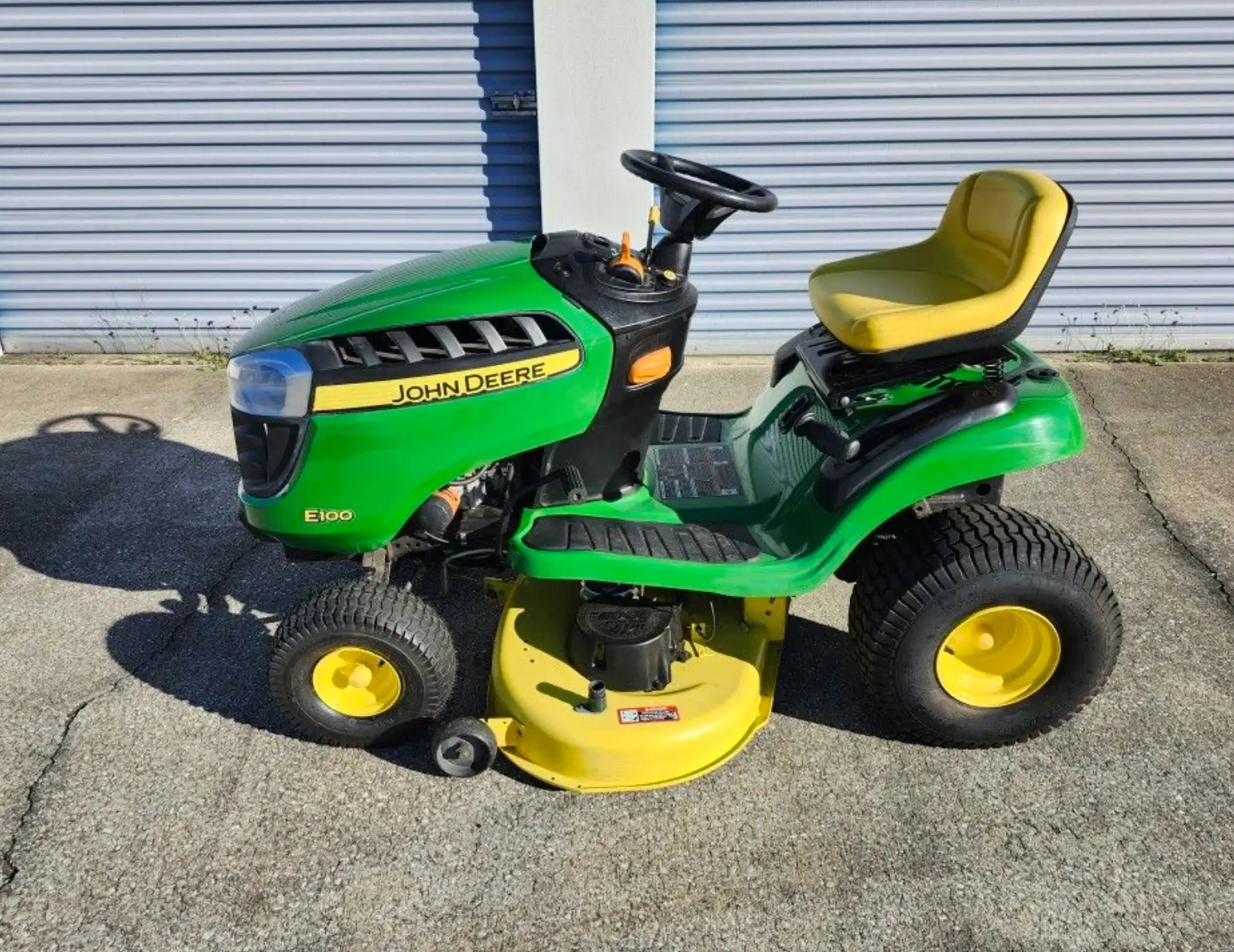
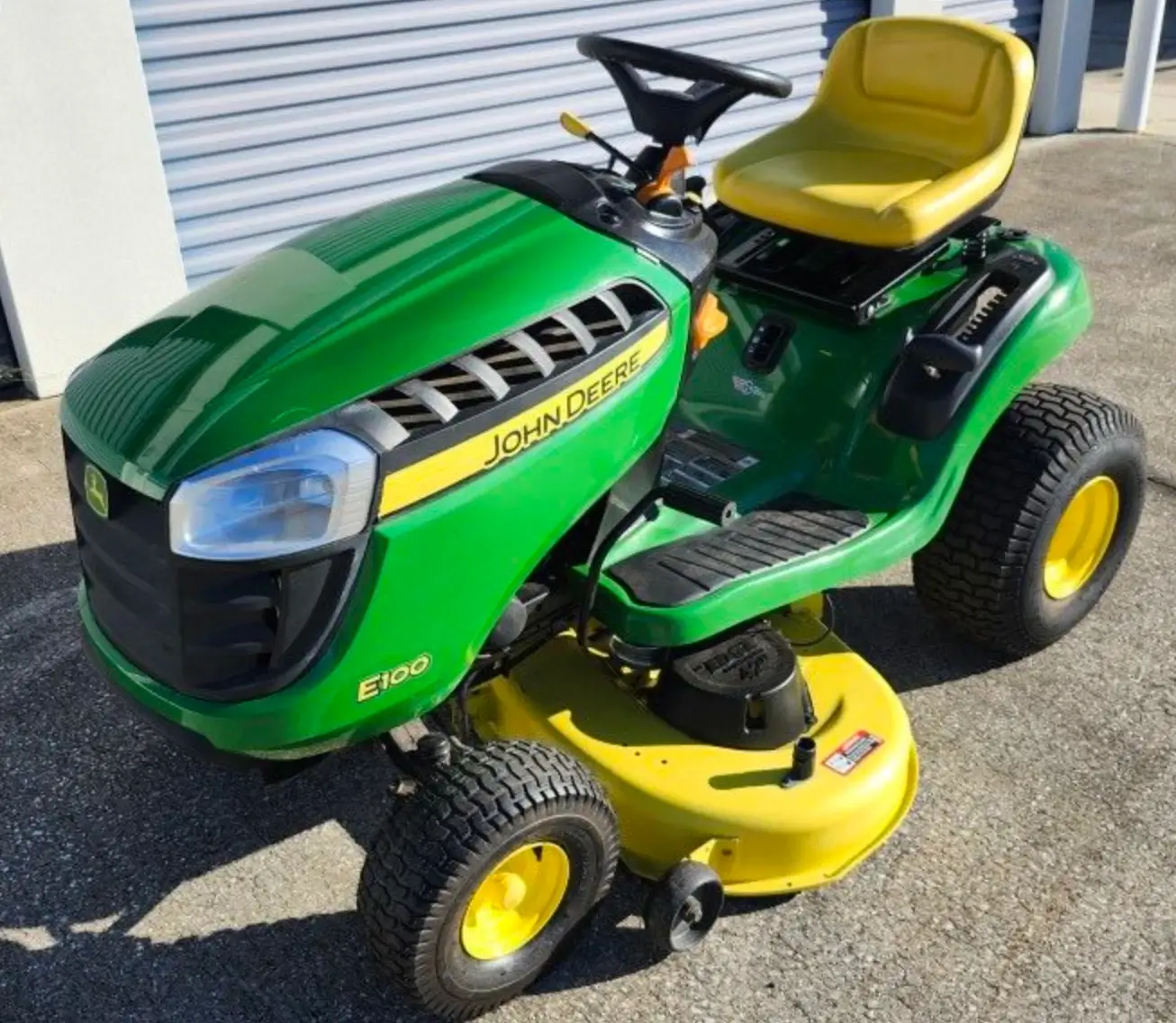
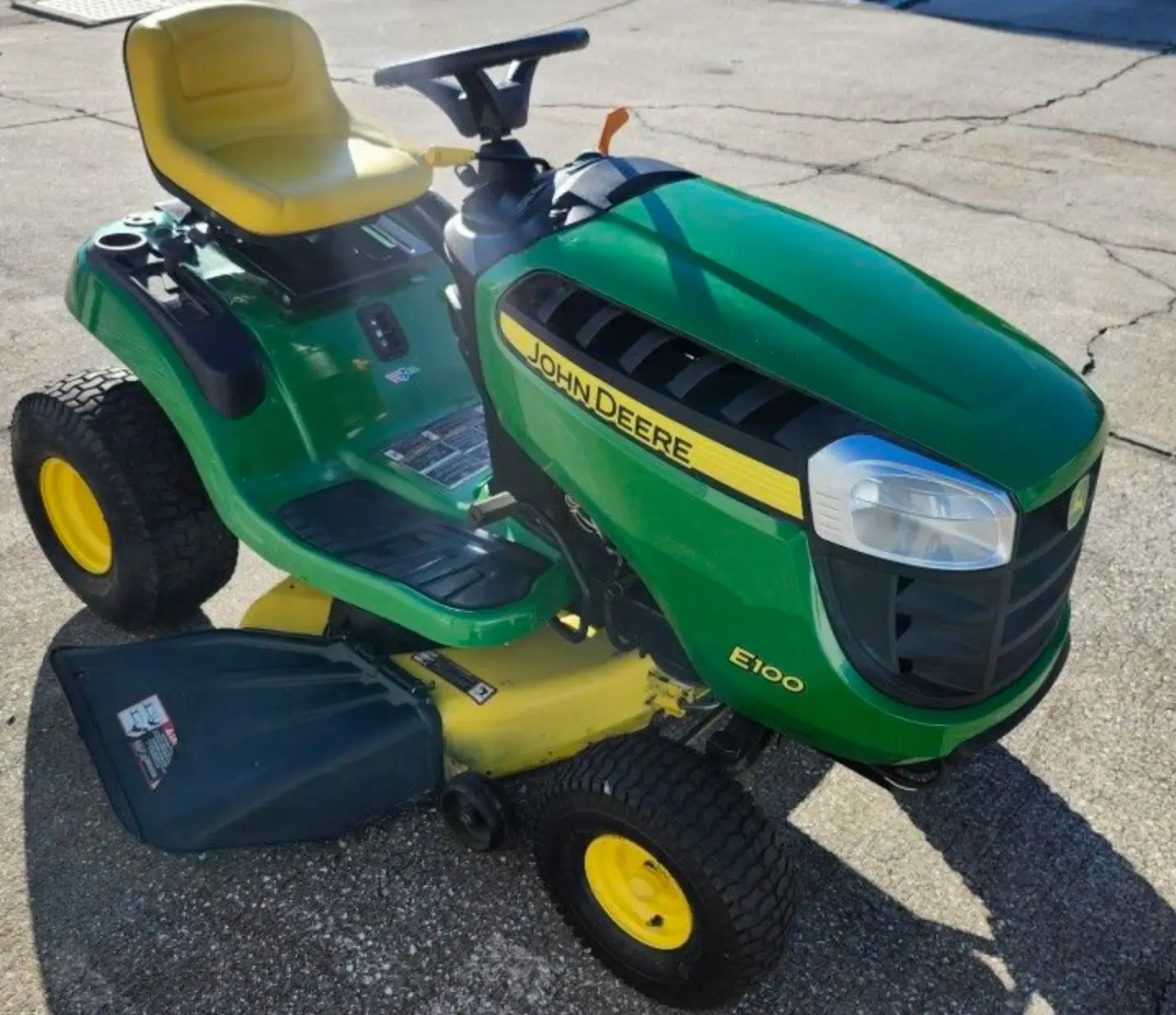
The John Deere E100 Series for sale is the go-to riding lawn mower for homeowners who want something simple, reliable, and worth something when it’s time to sell. Flat yards, 0.5–2 acres, nothing complicated — this is what it’s built for. Used units typically $1,500–$2,500 depending on condition.
- ✅ 42″–48″ cutting deck options
- ✅ 17.5–20 HP Briggs & Stratton engine
- ✅ Among the strongest resale values in its category
- ✅ John Deere dealer support across the US
- ✅ Used units $1,500–$2,500 — new also available
👉 Contact us for current stock, photos, and best price →
John Deere E100 Series for Sale — Buying Guide (2026)
John Deere E100 — Quick Facts
🌿 Best for: Flat yards, 0.5–2 acres
📐 Deck: 42″–48″
⚙️ Engine: 17.5–20 HP Briggs & Stratton
💰 Price: Used $1,500–$2,500 — new $1,800–$2,800
✅ Bottom line: The safest used mower purchase you can make — strong parts supply, holds value, dealer everywhere
The John Deere E100 is not the most powerful mower on this page, and it’s not the cheapest either. What it is — consistently — is the easiest to resell, the easiest to get serviced, and the one most buyers already know how to use. For a flat yard under 2 acres, it does everything you need without any drama.
One thing most buyers don’t realise until they’re trying to sell: a clean, well-maintained E100 moves faster in local listings than newer, neglected machines from other brands. John Deere green sells. That’s not marketing — that’s just how the used market works.
We’ve sold a lot of these. The buyers who come back happiest are the ones who weren’t chasing specs — they just wanted something that starts every time, cuts clean, and doesn’t become a project. That’s the E100. View the full range on the official John Deere website →
Specs
| Spec | Detail |
|---|---|
| Engine | Briggs & Stratton — 17.5–20 HP (varies by model) |
| Deck options | 42″, 48″ |
| Cutting height | 1″ – 4″ (6 positions) |
| Top speed | 5.5 mph forward / 3.2 mph reverse |
| Transmission | Automatic (E100) or hydrostatic (E130/E150) |
| Drive | Rear-wheel |
| Fuel tank | 2.4 gallons |
| Weight | ~420–460 lbs |
| Turning radius | 18″ |
| Warranty (new) | 2-year bumper-to-bumper |
Honest Pros and Cons
| What’s good | What’s not |
|---|---|
| Holds its value better than any comparable brand at resale | Lower HP than Cub Cadet XT1 at the same price |
| Parts and service available at dealers nationwide | 2-year warranty — some competitors offer 3 |
| Simple to operate and maintain — nothing tricky here | Not the right machine for slopes above 15° |
| Lighter than most competitors (~420–460 lbs) | Max 48″ deck — zero-turns go wider |
| Briggs & Stratton engine — serviced everywhere | Slower than a zero-turn on open flat ground |
Which E100 Model Do You Actually Need?
| Your Situation | Go With | Why |
|---|---|---|
| Small yard, under 0.5 acres | E100 42″ | Lightest and most maneuverable — don’t overbuy |
| 0.5–1.5 acres ⭐ Most common | E120 or E130 42″ | Most popular E100 models — easiest to find used with full history |
| 1.5–2 acres | E150 48″ or E160 48″ | Wider deck cuts more per pass — saves time on larger yards |
| Buying used, want safety ⭐ | Any E100 with dealer service history | JD documentation culture is strong — history is easier to verify than most brands |
| Care most about resale | Any E100 model, well maintained | John Deere green is the safest exit — commands premium on used market |
Is It the Right Machine for You?
If your yard is flat, under 2 acres, and you want the simplest path to a clean lawn without learning a new skill — yes, absolutely. The automatic transmission on the base E100 is genuinely point-and-go. You don’t have to think about it.
If your yard has real hills, look at the Cub Cadet XT1 instead. It handles slopes better, and buying the wrong machine for hilly ground is a safety issue, not just a performance one. If your yard is large and flat and you want to cut the time in half, a Husqvarna Z254 zero-turn will do it faster. The E100 sits squarely in the middle — not the fastest, not built for hills, but reliable and easy to own for years.
One thing worth knowing: John Deere’s used market is unusually healthy. These machines show up on TractorHouse and local listings regularly, with proper documentation, at predictable prices. If you price a clean E100 right, it usually sells within a week — that’s not true of every brand. Cub Cadet and Husqvarna take longer to move at equivalent prices in most local markets.
New vs Used — What to Expect
New E100 series machines run $1,800–$2,800. Skip the base E100 if you can — step up to the E130. The hydrostatic transmission is genuinely more pleasant day-to-day, especially if you’re reversing frequently or working around tight spots. Once you’ve used hydrostatic you tend not to go back.
The 2-year bumper-to-bumper warranty is solid. John Deere dealers handle claims without much friction, which matters more than you’d think when something actually breaks during year one.
On the used side, budget $1,500–$2,500. Age matters less than maintenance history. A 6-year-old machine with dealer stamps and clean oil is a better buy than a 3-year-old one with zero paperwork. Good used E100s move fast — most are gone within a week of listing. Check TractorHouse to benchmark real selling prices in your area before you start negotiating.
We update our stock weekly — reach out and we’ll send you what’s currently available with condition details.
What Actually Goes Wrong After a Few Years
No mower is maintenance-free, and the E100 is no exception. Here’s what typically comes up on machines in the 3–6 year range:
- Drive belt: Usually the first thing to go. Replacement is $25–$60 in parts and a straightforward DIY job if you’re handy. At a dealer, budget $100–$150 including labour
- Deck spindle bearings: Start to go rough around 200–300 hours on machines that hit a lot of debris or mow at the same height constantly. You’ll hear it — a grinding or rumbling from under the deck. Parts run $30–$60 each; there are usually two or three spindles depending on deck width
- Battery: Most go at 3–5 years. A replacement is $50–$80. Not a drama, but worth checking on any used machine
- Seat comfort on longer sessions: Honest answer — the 15″ seat on the base E100 is fine for 30–45 minutes. Beyond that, the lack of suspension starts to tell. If you’re mowing for an hour or more regularly, the E130 with its slightly improved seat is worth the extra money, or budget for an aftermarket seat cushion
- Vibration: More noticeable than on zero-turns because the engine is closer to the operator. Nothing unusual for a riding mower — but if vibration increases suddenly, check the blade balance first before assuming something serious
None of this is alarming for a machine in this category. The point is: build these costs into your used purchase assessment. A machine that needs a belt and a battery is still a good buy at the right price.
The E100 vs XT1 comparison is more nuanced than “flat vs hills.” Both machines have rear-wheel drive and handle gentle slopes fine. The real difference shows up above 12–15° — that’s where the XT1’s higher HP ceiling and slightly lower centre of gravity give it a meaningful edge. On a 5° slope, either machine is comfortable. On a 20° slope, neither is safe. The E100’s cut quality — particularly with the 48″ deck — is generally cleaner than the XT1 at the same settings, which matters if you care about how the lawn looks after.
Against the Husqvarna Z254, it’s not really a fair comparison for flat ground — the Z254 will cut the same yard 30–40% faster. But the E100 is easier to learn, cheaper to buy, and a lot less intimidating if you’re not used to zero-turn lap-bar steering. Some buyers genuinely prefer the E100 even on flat ground.
| John Deere E100 | Cub Cadet XT1 | Husqvarna Z254 | |
|---|---|---|---|
| Type | Riding mower | Riding mower | Zero-turn |
| Best terrain | Flat — fine up to ~12° | Slopes up to 15° — optimised | Flat only — avoid above 15° |
| Engine HP | 17.5–20 HP | 18–24 HP | 26 HP |
| Cut quality | Clean — especially 48″ deck | Good | Very good — wide fabricated deck |
| Resale | Among strongest in class | Good | Good |
| New price | $1,800–$2,800 | $1,800–$3,200 | $2,800–$3,200 |
| View listing | E100 listing | XT1 listing | Z254 listing |
Common Questions
How much does a John Deere E100 cost used in 2026?
Used E100 series machines typically list at $1,500–$2,500 in the current US market. Clean E120 or E130 examples with service history tend to sit at $1,800–$2,200. Older base E100s with higher hours can be found closer to $1,200–$1,500 — but check maintenance history carefully before going that low. Prices are higher than most comparable brands because JD holds value.
What’s the difference between the E100 and E120?
Engine size, mostly. The E100 has a 17.5 HP Briggs & Stratton; the E120 bumps to 20 HP on the same 42″ deck with the same automatic transmission. In practice, for a yard under an acre, you probably won’t notice the difference. For 1–1.5 acres, the E120 handles thicker grass and slight inclines with more confidence. Neither is a powerhouse — that’s not the point of this machine.
What are common John Deere E100 problems?
The most common issues are belt wear (the deck belt typically needs replacing every 3–4 years on regularly used machines), carburetor gumming if stored with old fuel, and battery failure on machines that sit through winter without a trickle charger. None of these are expensive or complicated to fix — they’re the normal maintenance catch-up items on any used riding mower. The transmissions on these machines are generally reliable if they’ve been looked after.
What oil does the John Deere E100 use?
SAE 10W-30 for most operating conditions — that’s the standard recommendation for Briggs & Stratton engines in this range. In temperatures consistently above 40°F, 10W-30 covers it. For very cold starts (below 0°F), 5W-30 is sometimes recommended. Change it every 50 hours or once a season, whichever comes first. It’s one of the simpler maintenance items on this machine.
Is the John Deere E100 a good mower under $2,500?
For flat residential yards under 2 acres, yes — it’s one of the better options at that price. You’re getting a machine that’s easy to service, holds its value reasonably well, and has dealer support everywhere. The main thing you give up compared to a zero-turn is mowing speed and maneuverability around obstacles. For a straightforward suburban yard, that tradeoff is usually fine.
How hard is the John Deere E100 to maintain?
About as simple as a riding mower gets. Oil changes every 50 hours, blade sharpening once or twice a season, belt checks annually. The Briggs & Stratton engine is independently serviced at most small engine shops — you’re not locked into a dealer for routine work. Keeping up with the schedule matters though. Skipped maintenance is the most common reason used E100s show up with avoidable problems.
More to Read
- 📖 Is the John Deere E100 Worth It? — Honest Take
- 📖 Best Riding Lawn Mower for Hills
- 📖 Cub Cadet XT1 — better for slopes
- 📖 Husqvarna Z254 — faster on flat ground
👉 Check current John Deere E100 stock — photos, hours, and price →
Mary K –
We needed a riding mower for about an acre, and the E100 has worked well. The 42-inch deck fits around our landscaping nicely.