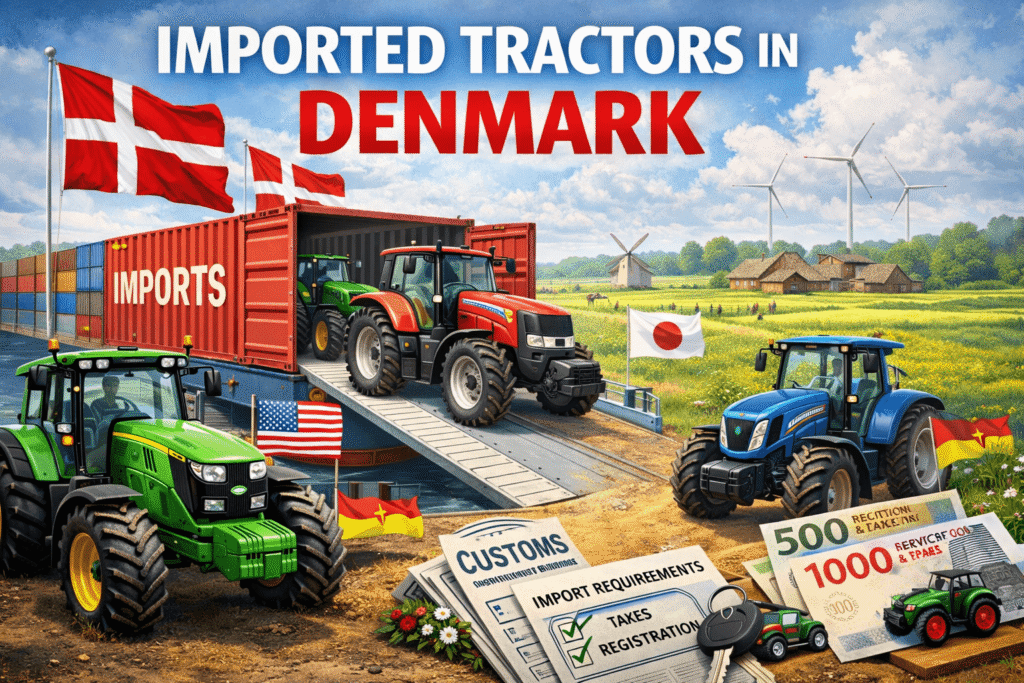
Imported tractors in Denmark are far more common than most buyers realise. A significant proportion of the used farm machinery sold through Danish dealers and private listings originates from Germany, the Netherlands, Belgium, and other EU farm markets. These machines can offer excellent value — but they come with specific risks that Danish-sourced machines don’t carry.
Are imported tractors worth it in Denmark? Yes — if sourced from Germany or the Netherlands and properly verified. Risks increase significantly with Eastern European imports where documentation standards are lower and outstanding finance is harder to confirm. Understanding the VAT framework, what to verify, and where the real risks lie is essential before committing to any imported tractor purchase in Denmark.
At Farmers Equipment Co., we source and supply tractors from across Europe, including imported machines for Danish buyers. This guide is based on European market sourcing experience, Danish dealer pricing data, and the most common issues we’ve seen arise on imported tractor purchases in Denmark. Here’s the honest picture in 2026.
Why Imported Tractors Are So Common in Denmark
Denmark is both a major importer and a major exporter of used agricultural machinery. The country’s large, well-documented farm operations generate quality trade-ins — which are exported to Norway, Sweden, Finland, and the Baltic states. At the same time, Danish dealers and buyers actively source machines from Germany, the Netherlands, and Belgium, where large arable operations regularly trade in high-specification tractors at competitive prices.
Three reasons drive import demand:
- Price — comparable machines in Germany or the Netherlands can sometimes be found at 5–15% lower prices than equivalent Danish listings, particularly for high-HP machines in the 150–250 HP range
- Supply — Denmark’s farm sector is large but not as vast as Germany’s or the Netherlands’. Cross-border sourcing gives Danish buyers access to a significantly wider pool of machines for specific makes, models, and specifications
- EU single market — intra-EU tractor imports carry no customs duties, making cross-border sourcing administratively straightforward
According to publicly available data from Statistics Denmark (Danmarks Statistik), agricultural machinery imports increased steadily between 2020–2025 as a share of Danish farm investment — a trend driven by EU single market efficiency and the consistent supply of quality machines from large-scale German and Dutch arable operations. For context on the wider Danish market, see our tractor market Denmark overview →
Where Do Imported Tractors in Denmark Come From?
| Source Country | What’s Available | Quality / Documentation | Best For |
|---|---|---|---|
| 🇩🇪 Germany | Wide range — all HP classes, most brands | Generally strong — large dealer networks, good records | Mid-to-high HP arable tractors (100–300 HP) |
| 🇳🇱 Netherlands | High-specification, high-HP machines from intensive arable operations | Very strong — Dutch large farms maintain meticulous records | High-spec 150–300 HP commercial machines |
| 🇧🇪 Belgium | Mixed range — good supply in the 100–200 HP range | Good — similar standards to the Netherlands | Mid-range arable and mixed farm tractors |
| 🇸🇪 Sweden / 🇫🇮 Finland | Nordic-spec machines — cold-weather build, often Valtra and Fendt | Very strong — Scandinavian documentation culture | Mixed and livestock farms — Nordic-condition machines |
| 🇵🇱 Poland / Eastern Europe | Older, higher-hour machines at lower prices | Variable — documentation standards lower, more risk | Budget only — requires careful independent inspection |
In our experience, the best-value imported tractors for Denmark consistently come from Germany and the Netherlands — well-documented machines from large commercial operations, priced competitively and with verifiable service histories. Scandinavian imports carry a slight premium but are particularly well-suited to Danish conditions. Eastern European imports carry meaningfully higher risk and require independent inspection before any purchase.
Are imported tractors cheaper in Denmark? Yes — typically 5–15% cheaper than equivalent Danish listings before transport and inspection costs. Final savings depend on sourcing country, condition, and how much of the price gap is absorbed by logistics. German and Dutch machines offer the strongest net value; Eastern European machines carry too much risk to recommend on price alone.
👉 Browse imported tractors available for Danish buyers →
Pros and Cons of Buying an Imported Tractor in Denmark
| Factor | ✅ Pros | ⚠️ Cons |
|---|---|---|
| Price | Can be 5–15% cheaper than Danish equivalents | Price advantage narrows after transport, inspection, and import costs |
| Selection | Access to wider range of makes, models, and specs | Harder to inspect in person before purchase |
| Documentation | German and Dutch machines often excellently documented | Records may be in foreign language — harder to verify |
| Dealer support | Major brands (John Deere, Fendt, MF) supported by Danish dealers regardless of origin | Some specialist or regional brands may lack Danish dealer support |
| Finance / liens | EU legal framework provides some buyer protection | Outstanding foreign finance is a real risk — harder to verify |
| Cold-climate history | Scandinavian imports have relevant climate experience | Southern EU imports may not have cold-start history |
| VAT | No customs duties on EU imports | VAT treatment can be complex — confirm before purchase |
VAT and Customs Rules for Importing a Tractor to Denmark
The legal and tax framework for importing tractors from within the EU to Denmark is relatively straightforward — but worth understanding clearly before purchase:
Intra-EU imports — no customs duties
Tractors imported from other EU member states (Germany, Netherlands, Belgium, France, Sweden, etc.) carry no customs duties. The EU single market removes tariffs on agricultural machinery trade between member states — making cross-border purchases administratively straightforward.
VAT treatment
For VAT-registered Danish farm businesses, the standard approach on intra-EU purchases is the reverse charge mechanism — you account for Danish VAT yourself rather than paying it at source. This is typically VAT-neutral for registered businesses. Private buyers who are not VAT-registered may need to pay Danish VAT (25%) on the imported value — your accountant should advise on the correct treatment for your situation.
Non-EU imports (UK, USA, Ukraine, etc.)
Importing from outside the EU involves standard customs duties (typically 0–4.5% on agricultural tractors depending on origin and classification) plus Danish VAT at 25% on the landed value. The Danish Customs Authority (Toldstyrelsen) provides definitive guidance on import duties for agricultural machinery entering Denmark from non-EU countries.
Registration
Any imported tractor that will be driven on Danish public roads must be registered with Motorstyrelsen and meet Danish road use requirements regardless of country of origin.
What to Check When Buying Imported Tractors in Denmark
Imported machines require additional verification steps beyond the standard used tractor inspection. These are the non-negotiable checks specific to imported tractors in Denmark. For the full mechanical inspection steps that apply to any used purchase, see our guide to buying a tractor in Denmark → and our used tractors for sale in Denmark guide →
Service records — language and verifiability
German service records are in German; Dutch records in Dutch. These are often high-quality and detailed — but you need either to read them yourself, have a bilingual contact review them, or use a translation service. Records you cannot verify are a risk you’re accepting blindly. Never purchase an imported machine without a clear understanding of what the service history actually says.
Outstanding finance from foreign lenders
This is the single biggest risk on imported tractors. A machine financed through a German or Dutch lender can arrive in Denmark with an undisclosed debt — and the lender may retain a legal claim against the asset. Always request written confirmation from the seller that no outstanding finance (or equivalent foreign term) exists on the machine, and if possible, run a verification check through the dealer or a specialist service.
Danish dealer serviceability
Confirm that a Danish authorised dealer for the brand can service the specific model before purchase. Major brands — John Deere, Fendt, Massey Ferguson, Valtra — are well-supported regardless of origin. Some regional brands or specialist models may not be.
Cold-start performance
Machines from southern EU countries (Spain, Italy, France) may not have been operated in cold-climate conditions. Test cold-start performance carefully — a machine that has never operated below 0°C may reveal issues in a Danish winter that weren’t visible at the point of purchase.
CE marking and technical compliance
All tractors sold in Denmark must comply with EU Machinery Directive requirements and carry CE marking. Machines from EU countries should carry this automatically — but verify, particularly on older models or imports from non-EU sources.
For a full inspection walkthrough, see our used tractors for sale in Denmark guide → which covers all standard inspection steps that apply equally to imported machines.
Common Risks on Imported Tractors — And How to Avoid Them
| Risk | How Common | How to Avoid It |
|---|---|---|
| Undisclosed foreign finance | Moderate — more common on Eastern EU imports | Written finance-free confirmation; dealer verification where possible |
| Unverifiable service records | Common on Eastern EU; low on German/Dutch | Bilingual review or independent translation before purchase |
| No Danish dealer support for brand | Low on major brands; higher on specialist/regional brands | Confirm with Danish dealer before purchase |
| Cold-climate performance unknown | Low on Nordic imports; moderate on southern EU | Cold-start test; ask specifically about winter operating history |
| Hour meter tampering | Low on German/Dutch; higher on Eastern EU | Cross-check hours against visible wear; independent inspection |
| VAT complexity | Low if VAT-registered; moderate for private buyers | Confirm VAT treatment with accountant before purchase |
The Danish Agriculture and Food Council (Landbrug & Fødevarer) provides guidance on agricultural machinery transactions and buyer rights in Denmark — including guidance relevant to imported machine purchases.
Are Imported Tractors Worth It in Denmark? — Honest Verdict
Yes — with the right source and the right checks. Here’s how to think about it:
✅ Imported tractors make sense in Denmark when:
- You’re sourcing from Germany, the Netherlands, or Scandinavia — well-documented machines from professional farming operations at competitive prices
- You need a specific make, model, or specification that isn’t readily available in Danish listings
- You’re buying through a trusted supplier who handles the import, inspection, and documentation process on your behalf
- The price advantage (after transport and inspection costs) still represents meaningful savings
- You can verify service records and confirm no outstanding foreign finance
⚠️ Imported tractors carry higher risk when:
- The source is Eastern Europe — variable documentation, higher finance risk, and greater likelihood of hour meter issues
- Service records are in a language you can’t read and no independent review is possible
- You cannot inspect the machine in person or commission an independent inspection before purchase
- The brand has no authorised Danish dealer for servicing and parts
For most Danish buyers, the safest route to a quality imported tractor is through a supplier who handles the sourcing, inspection, transport, and documentation process — eliminating the main risks while preserving the price advantages of cross-border purchasing.
For a broader look at the used tractor market in Denmark including domestic and imported options, see our used tractors for sale in Denmark guide →, our complete guide to buying a tractor in Denmark →, and our Denmark tractor buyer’s guide →
👉 Browse verified imported tractors ready for Denmark — confirmed service history →
👉 Ask our team about sourcing a specific model for Denmark →
Frequently Asked Questions: Imported Tractors in Denmark
Are imported tractors cheaper in Denmark?
They can be — typically 5–15% cheaper than equivalent Danish listings for machines sourced from Germany or the Netherlands. However, the price advantage narrows when you factor in transport costs (typically 5,000–15,000 DKK depending on distance), independent inspection fees, and any VAT adjustments. The net saving is real but more modest than the headline price difference suggests.
Do I pay customs duties on a tractor imported from Germany to Denmark?
No — intra-EU tractor imports carry no customs duties. The EU single market removes tariffs on agricultural machinery trade between member states. VAT treatment depends on whether you’re a VAT-registered business or private buyer — consult your accountant for the correct approach.
Are German tractors good quality for use in Denmark?
Generally yes — German large-farm trade-ins are typically well-maintained, properly documented, and from similar farming conditions to Denmark. German dealer service networks maintain high standards, and German-sourced machines from professional operations are among the most reliably documented in Europe. The main check is to verify service records are legible and confirm no outstanding German finance exists on the machine.
What is the risk of buying an imported tractor in Denmark?
The main risks are: undisclosed foreign finance, service records in a language you can’t verify, and lack of Danish dealer support for the brand or model. These risks are substantially lower on machines from Germany, the Netherlands, or Scandinavia, and substantially higher on Eastern European imports. Independent inspection and written finance confirmation before purchase address most of the risk.
Can I register an imported tractor in Denmark?
Yes — any tractor that will be driven on Danish public roads must be registered with Motorstyrelsen regardless of origin. The registration process for EU-origin machines is straightforward. Confirm the machine carries CE marking and meets Danish road use requirements before purchase.
Is it safe to buy a tractor from the Netherlands for use in Denmark?
Yes — Dutch large-farm trade-ins are among the most reliably documented in Europe. The Netherlands’ intensive arable sector produces high-specification machines with thorough service histories. The main check, as with any imported machine, is written confirmation of no outstanding Dutch finance. Dutch-origin machines are a consistently strong option for Danish buyers in the 150–300 HP range.