The tractor market in Denmark is one of the most active in Northern Europe — driven by large-scale arable consolidation, rising farm labour costs, and consistent demand for high-specification machinery. Understanding where the market stands in 2026 helps buyers time purchases better, choose the right HP range, and avoid overpaying in a market that moves with seasonal and economic cycles.
At Farmers Equipment Co., we supply tractors across Denmark and the wider Nordic region. This guide is based on publicly available Danish agricultural data, European manufacturer market reports, and pricing trends observed across Danish dealer networks in 2025–2026. Here’s what the Danish tractor market looks like right now.
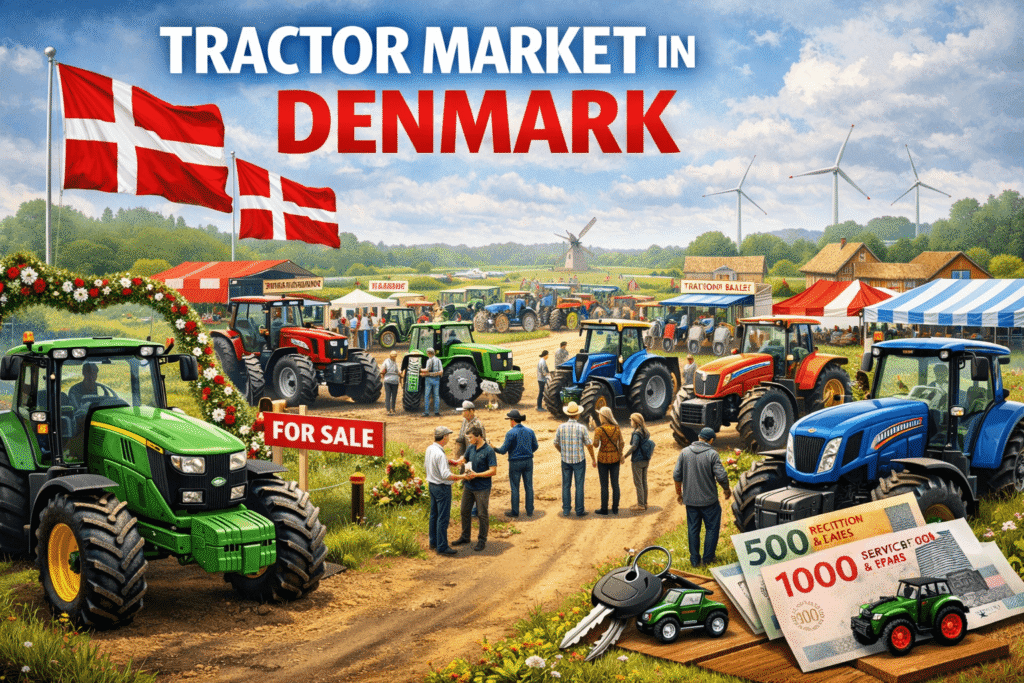
Danish Tractor Market — Size and Recent Growth
Denmark is a small country with a disproportionately large agricultural machinery market. Intensive dairy, pig, and arable farming across Jutland and the islands creates consistent, professional-grade demand for tractors and farm equipment that exceeds many larger European countries on a per-farm basis.
According to publicly available data from Statistics Denmark (Danmarks Statistik), the agricultural sector accounts for a significant share of Danish exports and continues to invest heavily in mechanisation as farm labour costs rise and operational scale increases. The trend toward larger, fewer, and more intensively mechanised Danish farm holdings has sustained consistent tractor market growth over the past decade.
Key market characteristics in 2026:
- Strong consistent demand driven by farm consolidation and labour replacement
- High average transaction values — Danish farms are widely regarded as among the most capital-intensive in Northern Europe
- Active used market with documentation standards commonly considered among the strongest in the EU
- Growing demand for precision farming technology integrated into new purchases
👉 Browse tractors for sale in Denmark — current listings →
What’s Driving Tractor Demand in Denmark in 2026
Several converging factors are shaping tractor demand in the Danish market this year:
Farm labour costs and mechanisation
Denmark has some of the highest agricultural labour costs in Europe. The economic case for replacing manual work with machinery is stronger here than in most EU countries — driving consistent demand for both new and used tractors across all farm sizes. This is particularly visible in the dairy and pig sectors, where automation and mechanisation investment has accelerated significantly.
Farm consolidation
The number of Danish farm holdings has declined steadily as operations consolidate into larger units. Larger farms require more powerful, higher-specification machinery — pushing demand toward the 130–200 HP segment and driving upgrades across the fleet. According to the Danish Agriculture and Food Council (Landbrug & Fødevarer), Danish agricultural production continues to concentrate in fewer, larger operations with increasingly sophisticated equipment requirements.
Precision farming adoption
Denmark is a European leader in precision agriculture — GPS guidance, variable rate application, and telematics are standard expectations on new tractor purchases in the professional segment. This is driving demand for tractors with integrated ISOBUS, auto-steer, and connectivity as baseline specifications rather than optional extras.
Sustainability and emissions
EU Stage V emissions requirements are now standard across new tractor sales in Denmark. Growing interest in HVO (hydrotreated vegetable oil) and alternative fuel compatibility is influencing brand and model selection — particularly among larger operations with sustainability reporting obligations.
Popular HP Ranges in the Danish Tractor Market
HP range demand in Denmark is shaped by the country’s predominantly flat, large-scale arable landscape — which favours higher horsepower than markets like Norway or Sweden. Here’s how demand breaks down by segment:
| HP Range | Market Share | Primary Buyers | Most Common Brands |
|---|---|---|---|
| Under 80 HP | ~15% | Small farms, hobby, equestrian, horticulture | Kubota, John Deere, Massey Ferguson |
| 80–130 HP | ~25% | Mixed farms, livestock, smaller arable | John Deere, Massey Ferguson, New Holland, Valtra |
| 130–180 HP | ~35% | Mid-to-large arable, dairy, contractors | John Deere, Fendt, New Holland, Massey Ferguson |
| 180–250 HP | ~18% | Large arable, commercial contractors | John Deere, Fendt, Case IH, New Holland |
| 250 HP+ | ~7% | Very large arable, specialist contractors | John Deere, Fendt, Case IH |
The 130–180 HP segment is the core of the Danish tractor market — this range offers the best combination of versatility, power, and cost-effectiveness for the medium-to-large arable and dairy farms that dominate Danish agriculture. It also produces the highest volume of quality used tractors as large farms rotate their fleets regularly.
Market-Leading Tractor Brands in Denmark (2026)
Based on dealer market structure and publicly available registration data, John Deere holds the largest market share in Denmark — driven by the widest dealer network, strongest resale values, and most advanced precision farming platform. The 6R and 7R series dominate in the professional arable segment.
Fendt holds the premium position — the Vario CVT transmission is widely regarded as the benchmark for fuel efficiency and operator comfort among Danish professional farmers. Fendt commands the highest used prices and strongest resale values in the premium segment.
Massey Ferguson and New Holland compete strongly in the mid-market — competitive pricing, strong parts availability, and proven reliability across Danish farming conditions make both brands consistently popular on mixed and livestock farms.
Valtra maintains a loyal following on smaller and mixed farms, particularly where Nordic build quality is valued. Kubota leads in the compact sub-80 HP segment, driven by hobby farm and equestrian demand.
Import Reliance and Sourcing Trends
Denmark imports a significant proportion of its tractor supply — both new machines from manufacturer export markets and used machines from other EU countries. Key trends in 2026:
- New tractors — sourced through authorised brand importers and dealer networks. All major brands have established Danish dealer presence
- Used tractors imported into Denmark — German, Dutch, and Belgian farm trade-ins are a significant source of quality used machines in the Danish market, particularly in the 100–200 HP range. These well-documented machines from large-scale EU arable operations are often competitively priced
- Denmark as a source market — Denmark is itself a major exporter of quality used tractors to Norway, Sweden, Finland, and the Baltic states. Danish-sourced machines are prized for their documentation standards and maintenance quality
Within the EU single market, there are no customs duties on intra-EU tractor imports — making cross-border sourcing straightforward for Danish buyers and dealers alike.
Tractor Price Movements in Denmark (2026)
Danish tractor prices in 2026 reflect the broader European market pattern — new machine prices have increased over the past three years driven by supply chain pressures and input cost inflation, while the used market has remained more stable with some softening at the top end.
| Segment | New Price Range (DKK) | Used Price Range (DKK) | Price Trend 2025–2026 |
|---|---|---|---|
| Compact (under 80 HP) | 150,000 – 650,000 | 60,000 – 350,000 | Stable — steady demand, good supply |
| Mid-range (80–130 HP) | 700,000 – 1,200,000 | 300,000 – 700,000 | Slight softening on used; new stable |
| Core segment (130–180 HP) | 900,000 – 1,500,000 | 400,000 – 900,000 | Stable — highest volume, consistent demand |
| Large (180–250 HP) | 1,500,000 – 2,500,000 | 700,000 – 1,400,000 | Softening slightly on used; new unchanged |
| High-HP (250 HP+) | 2,500,000 – 4,000,000+ | 1,200,000 – 2,200,000 | Stable — specialist segment, limited supply |
For buyers, the current market presents a reasonable opportunity in the used segment — particularly on machines aged 4–7 years in the 130–180 HP core range where supply is good and prices have softened slightly from 2024 peaks.
👉 Browse used tractors for sale in Denmark — current pricing →
The Danish Used Tractor Market in 2026
The Danish used tractor market is one of the best in Europe for buyers — high documentation standards, consistent supply from large farm trade-ins, and a strong export market that keeps quality levels high. Key characteristics in 2026:
- Best buying window: autumn (October–November) when post-harvest trade-ins flood the market. December–January is strongest for new machine deals as dealers push year-end targets
- Best value segments: 130–180 HP, 4–7 years old — highest supply, most competitive pricing, and strongest dealer documentation
- Brands with strongest used supply: John Deere and Massey Ferguson dominate used listings volume; Fendt commands the highest used prices
- Documentation quality: significantly better than Germany, France, or Eastern Europe — dealer-stamped service histories are the norm on professional-grade Danish trade-ins
For a full guide to the Danish used tractor market, see our used tractors for sale in Denmark guide → and our complete Denmark tractor buyer’s guide →
2026 Outlook — What Buyers Should Know
The Danish tractor market in 2026 is characterised by stability rather than dramatic swings. For buyers, the key takeaways:
- New machines: prices are unlikely to fall significantly in 2026. If you’re buying new, year-end dealer deals (November–December) remain the best pricing window
- Used machines: slight softening in the upper-mid segment creates a reasonable buying opportunity — particularly for 4–7 year old machines in the 130–200 HP range
- Technology: the gap between new and 5-year-old machines on precision farming technology is widening. Buyers who need current GPS, ISOBUS, and telematics should factor this into their used vs new decision
- Sustainability: HVO and alternative fuel compatibility is increasingly relevant for buyers selling into supply chains with sustainability requirements. Confirm fuel compatibility before purchasing any machine post-2019
- Import opportunity: well-documented used machines from Germany and the Netherlands continue to offer good value for Danish buyers — the intra-EU framework makes this a lower-risk sourcing route
👉 Browse tractors for sale in Denmark — updated daily →
👉 Talk to our team about current Danish market availability →
Frequently Asked Questions: Danish Tractor Market 2026
How big is the tractor market in Denmark?
Denmark’s tractor market is one of the most active in Northern Europe relative to farm count — driven by large-scale, intensively mechanised farm operations across Jutland and the islands. New tractor registrations run into the thousands annually, and the used market is exceptionally active with high documentation standards that attract buyers from across Scandinavia and the Baltic states.
What is the most popular tractor brand in Denmark?
John Deere holds the largest market share in Denmark, driven by the widest dealer network, strongest resale values, and most advanced precision farming platform. Fendt holds the premium segment. Massey Ferguson and New Holland compete strongly in the mid-market, with Valtra popular on smaller and mixed farms and Kubota leading in the compact segment.
What HP range is most popular in Denmark?
The 130–180 HP segment is the core of the Danish tractor market — approximately 35% of annual sales. This range suits Denmark’s flat, large-scale arable and dairy farming landscape. It also produces the highest volume of quality used machines as large farm operations regularly trade in fleet equipment.
Are tractor prices rising or falling in Denmark in 2026?
New tractor prices in Denmark are broadly stable in 2026 after several years of increases. The used market has seen slight softening in the 130–200 HP range, creating a reasonable opportunity for used buyers. Compact and specialist segments remain stable. Year-end (November–December) dealer deals continue to offer the best pricing on new machines.
Is Denmark a good place to buy a used tractor?
Yes — one of the best in Europe. Denmark’s documentation culture produces quality used tractors with complete, verifiable service histories. Large farm trade-ins generate consistent supply of well-maintained professional-grade machines. The country is also a major used tractor export source for Norway, Sweden, and the Baltic states — which reflects the quality and reliability of the supply.
When is the best time to buy a tractor in Denmark?
Autumn (October–November) for used tractors — post-harvest trade-ins create the year’s highest volume and most competitive pricing. November–December for new tractors — dealer year-end targets drive genuine flexibility on price, financing terms, and added extras. For a full seasonal breakdown, see our Denmark tractor buyer’s guide →