Norway is one of the most electrified countries in the world — with the highest EV adoption rate per capita and some of the most ambitious green energy targets in Europe. So it makes sense that Norwegian farmers are asking the question: are electric tractors in Norway actually worth buying in 2026?
The honest answer: it depends on your farm. Battery-powered agricultural machinery has moved from concept to limited commercial reality faster than most expected — but it’s still not the right choice for every operation. In this guide, we look at what’s realistically available, what it costs, what subsidies cover, and where the technology genuinely delivers — and where it still falls short.
At Farmers Equipment Co., we supply both conventional and electric farm equipment across Norway and the Nordic region. The observations in this guide draw on field feedback from Scandinavian farm operators, European manufacturer specifications for 2025–2026 models, and dealer service data from Nordic tractor imports. This is our honest take — not a sales pitch.
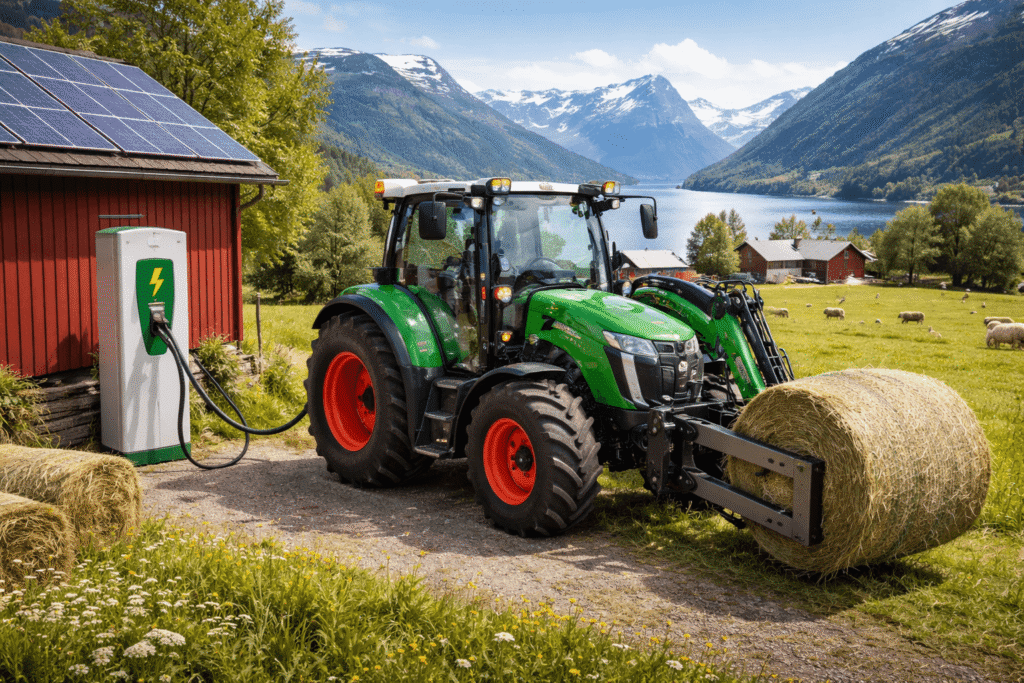
⚡ Quick Verdict: Electric Tractors in Norway (2026)
| Factor | Summary |
|---|---|
| Best fit | Farms replacing one mid-size tractor used daily for loader work and light field tasks |
| Good for | Small-to-medium farms, 20–80 HP tasks, horticulture, precision applications |
| Not ideal for | Long heavy-draft field work, remote farms without grid access, high-hour commercial operations |
| Upfront cost | Typically 40–80% higher than diesel equivalent before grants |
| Running costs | Significantly lower — Norway’s cheap hydro electricity makes this compelling |
| Subsidies | Innovasjon Norge grants available — can meaningfully reduce net purchase cost |
| Overall | Viable and increasingly practical for the right Norwegian farm — but situational in 2026 |
Electric Farm Equipment in Norway — Where the Market Stands
The market for electric farm equipment in Norway is still in its early commercial phase — but progressing faster than most of Europe. Norway’s combination of high diesel costs, clean electricity, strong environmental policy, and government equipment grants has created some of the most favourable conditions on the continent for low-emission agricultural machinery.
According to publicly available data from Statistics Norway (SSB), farm mechanisation investment has grown consistently over the past decade, with environmental compliance increasingly influencing equipment decisions — particularly on farms near protected waterways and national park boundaries.
Interest from Norwegian farmers is currently strongest in the 20–50 HP compact range — where electric farm equipment in Norway is most developed and daily task cycles align best with current battery durations. This is particularly relevant for fjord-side farms in Vestland, smaller mixed operations in Trøndelag, and horticulture holdings across the west coast where compact, emissions-free machinery fits naturally into the farm setup. Above 100 HP, commercially available options remain limited, with several manufacturers in testing or early market rollout phases as of 2026.
Electric Tractors: Models in Commercial Production or Limited Rollout in Europe
Availability of specific models in Norway varies by dealer network, import approval, and regional distribution — always confirm with a Norwegian dealer before making any purchase decision. The following reflects the European commercial landscape as of early 2026:
Models in Commercial Production (European market)
| Brand / Model | Power (kW / HP equiv.) | Typical Runtime per Charge | Primary Use Case |
|---|---|---|---|
| Fendt e100 Vario | 50 kW / approx. 67 HP | 4–6 hrs (light load) | Horticulture, precision tasks, indoor/greenhouse work |
| New Holland T4 Electric Power | 66 kW / approx. 88 HP | 4–5 hrs (standard work) | Small-to-medium farms, loader work, light cultivation |
| Solectrac e70N | 52 kW / approx. 70 HP | 4–8 hrs (task-dependent) | Small farms, livestock operations, horticulture |
Models in Limited or Pilot Rollout in Europe (2026)
| Brand / Model | Power (kW / HP equiv.) | Status | Notes for Norwegian Buyers |
|---|---|---|---|
| Valtra Q305e | 125 kW / approx. 168 HP | Limited rollout — availability varies by market | Contact Norwegian Valtra dealer to confirm availability and delivery timeline |
| Monarch Tractor MK-V | 70 kW / approx. 94 HP | Available in select European markets | Precision/autonomous farming focus — confirm Norwegian dealer support before ordering |
In our experience, Norwegian buyers are most commonly asking about the Fendt e100 and New Holland T4 Electric Power — both in commercial production, with European dealer support networks. For higher-horsepower options, the market is still developing.
👉 Browse low-emission tractors available for Norwegian buyers →
Hidden Costs of Electric Tractors in Norway (What Most Guides Miss)
The purchase price and fuel savings get most of the attention — but several additional costs are consistently underestimated by first-time buyers of battery-powered farm machinery.
Battery Replacement
Battery packs on current commercial electric tractors are typically warrantied for 5–8 years or a set number of charge cycles. After that, replacement can cost somewhere in the range of 150,000–300,000 NOK depending on the model — a significant expense that can substantially change the total cost of ownership calculation. This is one of the most commonly underestimated risks with first-generation electric farm machinery, and worth factoring in before committing.
Charging Infrastructure
Most farms already have three-phase electrical supply, but upgrading to a fast-charge capable installation suitable for commercial tractor charging can cost roughly 20,000–60,000 NOK depending on existing infrastructure. This is a one-time cost, but should be budgeted upfront — not discovered after delivery.
Downtime Risk During Intensive Seasons
If a battery-powered tractor runs short of charge mid-task, recovery is slower than a diesel refuel. During intensive seasonal work — haymaking, harvest, spring cultivation — losing several hours to recharging has real operational consequences. Planning daily task schedules around battery capacity requires adjustment and forward planning.
Resale Uncertainty
The used market for electric agricultural machinery in Norway is still at an early stage. Resale values for first-generation machines are genuinely uncertain — battery degradation, rapidly evolving technology, and a limited used-buyer pool all create risk. If you plan to sell within 5–7 years, factor this into your investment calculation.
Reported Case Pattern — Small Livestock Farm, Western Norway
Based on reported experiences from small livestock and hay operations in western Norway (farms of approximately 80 decare running around 500 hours of annual tractor use), operators who switched to electric compact tractors with partial Innovasjon Norge grant support in 2024–2025 have generally reported: significant fuel cost reductions, daily task cycles (loader work, hay cutting, light cultivation) comfortably within battery range for most work, occasional mid-day recharging needed during intensive hay periods, and an overall assessment that the switch worked well for their specific workload — but required more daily planning than diesel. This pattern is consistent with the operational profile where electric tractors perform best.
Electric Tractor Price in Norway (2026)
Based on European market pricing as of early 2026, electric tractor prices in Norway for commercially available models in the 50–80 HP class typically fall somewhere in the range of 800,000–1,500,000 NOK before grants — compared to 500,000–900,000 NOK for a comparable diesel machine. The price premium over diesel is generally in the range of 40–80% depending on model and specification.
After Innovasjon Norge grant support (where applicable), the effective net cost can be meaningfully lower — making the comparison with diesel less stark than the headline figures suggest. Always confirm current dealer pricing and grant terms before budgeting.
Total Cost of Ownership — Electric vs Diesel
Battery-powered tractors carry a significant purchase price premium over equivalent diesel machines — typically in the range of 40–80% more at the point of sale, based on publicly available European manufacturer pricing. The following comparison is indicative for the Norwegian market; actual figures vary by model, dealer, grant eligibility, and energy costs:
| Cost Component (10-year estimate) | Diesel ~650 HP class (NOK) | Electric equivalent (NOK) |
|---|---|---|
| Purchase price | ~500,000–900,000 | ~800,000–1,500,000 |
| Fuel / energy (10 years, 500–700 hrs/yr) | ~500,000–700,000 | ~80,000–180,000 |
| Servicing (10 years) | ~200,000–300,000 | ~100,000–180,000 |
| Battery replacement (if needed) | — | ~150,000–300,000 (risk factor) |
| Charging infrastructure (one-time) | — | ~20,000–60,000 |
| Innovasjon Norge grant (if eligible) | — | Potentially −100,000 to −200,000 |
| Estimated payback on premium | Typically 7–14 years depending on usage intensity, subsidy level, and whether battery replacement is needed | |
Norway’s economics advantage is significant: high diesel costs, cheap renewable electricity, and Innovasjon Norge grant support together make the long-term cost case for electric farm machinery more compelling here than almost anywhere in Europe. Whether the numbers work for your specific farm depends on annual hours, grant eligibility, and whether battery replacement is needed within your ownership period.
Norwegian Grants and Policy Support
Innovasjon Norge — the Norwegian government’s business support agency — provides investment grants for electric and low-emission farm equipment. In qualifying cases, grant support can cover a meaningful portion of the price premium over a comparable diesel machine. Grant availability and terms change by funding cycle, so always check current terms and apply before ordering — retroactive applications are typically not accepted. Local Felleskjøpet Agri advisors can guide you through the application process.
Norwegian agricultural businesses may also benefit from standard farm investment tax treatment on electric machinery — including depreciation allowances. Norway’s participation in the European Economic Area (EEA) also aligns with EU Farm to Fork strategy frameworks, which creates longer-term tailwinds for farms selling into European supply chains that increasingly require carbon reporting.
Operational Realities — Range, Cold Weather, and Power
Three factors define whether an electric tractor works for a specific Norwegian farm operation:
Daily Task Range
Most commercially available models in the 50–100 HP class typically deliver somewhere in the range of 4–6 hours per charge under standard working conditions — though this varies significantly by task, terrain, and temperature. For lighter tasks (loader work, precision spraying, horticulture), this is often sufficient for a full shift. For sustained heavy cultivation or large-scale mowing, current battery capacity is a genuine constraint for many Norwegian operations.
Cold Weather Impact
Cold temperatures reduce battery capacity — a particularly relevant factor for Norwegian farmers. Based on widely reported field experience with battery equipment in Nordic conditions, expect approximately 10–20% reduced runtime in winter conditions. Overnight charging in a warm farm building helps maintain performance. This is improving with each battery generation but remains a real planning factor in 2026.
Power and Torque Characteristics
Electric motors deliver full torque instantly — an advantage for loader work, short cultivation runs, and precision tasks. The power delivery feels more responsive than diesel at equivalent HP ratings. For sustained high-draft work over many hours, diesel retains a practical edge in 2026.
How Well Suited Are Electric Tractors to Norwegian Conditions?
| Norwegian Factor | Impact on Suitability |
|---|---|
| High diesel prices | ✅ Strong advantage — running cost savings more compelling than most of Europe |
| Cheap renewable electricity | ✅ Strong advantage — Norway’s hydro grid keeps charging costs low and carbon footprint minimal |
| Innovasjon Norge grants | ✅ Strong advantage — can significantly reduce net purchase cost |
| Small-to-medium farm scale | ✅ Good fit — most Norwegian farms operate in the 20–80 HP range where options are strongest |
| Cold winters | ⚠ Moderate challenge — typically reduces battery range by 10–20% |
| Steep and demanding terrain | ⚠ Moderate challenge — higher power draw on slopes reduces effective range |
| Remote farm locations | ⚠ Moderate challenge — charging infrastructure needed on-farm; grid access may be limited |
| Short, intensive growing seasons | ⚠ Some risk — extended high-intensity use may push beyond daily battery capacity during peak periods |
Electric vs Diesel in Norway — Decision Summary
| Factor | Diesel | Electric | Winner in Norway |
|---|---|---|---|
| Upfront cost | Lower | 40–80% higher before grants | Diesel (short-term) |
| 10-year running cost | High — diesel expensive in Norway | Low — hydro electricity cheap | Electric (long-term) |
| Operational flexibility | Unlimited range, fast refuel | 4–8 hrs per charge, slower recovery | Diesel |
| Cold weather performance | Reliable in Norwegian winters | ~10–20% range reduction in cold | Diesel (slight edge) |
| Environmental credentials | High emissions, rising compliance risk | Near-zero on Norway’s hydro grid | Electric strongly |
| Resale market | Established, predictable values | Immature, uncertain in 2026 | Diesel |
| Future regulation risk | Increasing pressure on diesel | Aligned with EU/Norway direction | Electric (long-term) |
| Grant support | None | Innovasjon Norge — meaningful reduction | Electric |
Honest Verdict: Are Electric Tractors Worth It in Norway in 2026?
✅ Electric tractors make more sense in Norway in 2026 if:
- Your farm operates in the 20–80 HP range and daily tasks typically fit within 4–6 hour battery windows
- You qualify for Innovasjon Norge grants that reduce the upfront premium to manageable levels
- You have three-phase electricity on-farm for overnight charging
- Your work is concentrated in shorter, repeated cycles — loader work, horticulture, precision applications
- You prioritise lower running costs and emissions and plan to hold the machine long enough for payback
⚠ Electric tractors are harder to justify in Norway in 2026 if:
- You run sustained heavy-draft work across long daily hours
- You farm in very remote locations without reliable grid access
- You plan to sell or trade up within 5–7 years — resale values remain uncertain
- The upfront premium isn’t offset by grants and the payback period is unattractive given your usage
Our honest read: for the right Norwegian farm, a battery tractor in 2026 is a genuinely viable and increasingly attractive option — not just an environmental statement. For farms that push machines hard across long daily hours in demanding conditions, diesel remains more practical for now. The technology is improving fast, and the economics will shift — but in 2026, the match between machine capability and farm needs is still the deciding factor.
Prices vary significantly by dealer, import route, and exchange rate — always confirm local Norwegian pricing before purchase.
Why Some Norwegian Farmers Still Hesitate in 2026
Even farmers who are interested in battery tractors in Norway often hold back — and their reasons are worth taking seriously:
- Battery replacement uncertainty — not knowing when a battery pack will need replacing (and at what cost) makes long-term budgeting difficult
- Immature resale market — there’s no established used market for electric farm machinery in Norway yet, which creates real uncertainty if you need to sell
- Charging downtime anxiety — particularly during intensive seasonal work, the risk of running short of charge and losing hours of fieldwork time is a genuine concern
- Lack of high-HP options — for farms that need 100+ HP, the commercially available electric range is still very limited in 2026
- Distance to service centres — in remote Norwegian regions, the prospect of a fault requiring specialist diagnosis without a nearby dealer is a real risk with any newer technology
These are legitimate hesitations, not just technophobia. For some Norwegian operations, the honest answer is that 2026 is still too early — and waiting until the resale market matures and battery technology advances further is the right call.
👉 If your farm is under 80 HP and you run daily loader work or light field tasks → electric farm equipment in Norway may be a fit — browse options →
👉 If you exceed 700 hours/year or need heavy-draft capability → compare diesel tractors for sale in Norway first →
👉 Not sure? Talk to our team — we’ll be straight with you about which option fits →
Frequently Asked Questions: Electric Tractors in Norway
Are electric tractors available to buy in Norway in 2026?
Several models are in commercial production in Europe, including the Fendt e100 Vario and New Holland T4 Electric Power. Availability in Norway specifically varies by dealer and region — always confirm with a Norwegian dealer before committing. Models above 100 HP are in limited rollout phases with availability varying significantly.
How much do electric tractors cost in Norway?
Based on European market pricing, electric tractor prices in Norway for the 50–80 HP class typically fall somewhere in the range of 800,000–1,500,000 NOK — roughly 40–80% more than a comparable diesel machine. Innovasjon Norge grants can reduce the effective net cost in qualifying cases. Prices vary by dealer, import route, and exchange rate — always confirm local Norwegian pricing before purchase.
Can I get a grant for buying an electric tractor in Norway?
Yes. Innovasjon Norge offers investment support for electric and low-emission agricultural machinery. Grant terms and availability change by funding cycle — always check current terms and apply before ordering. Local Felleskjøpet Agri advisors can help navigate the application process.
How long does a charge last on an electric tractor?
Most commercially available models in the 50–100 HP class typically deliver somewhere in the range of 4–6 hours per charge under standard working conditions. This varies significantly by task, terrain, and temperature — cold Norwegian winters can reduce effective runtime by approximately 10–20% based on widely reported Nordic field experience.
Do electric tractors work well in Norwegian winters?
They operate in Norwegian winter conditions, but cold temperatures reduce battery capacity — typically in the range of 10–20% based on reported Nordic experience. Overnight charging in a warm building helps maintain performance. Electric motors start instantly in cold temperatures, which is an operational advantage over some diesel machines in extreme conditions.
What are the best electric tractor brands for Norwegian farms?
Fendt and New Holland currently lead on commercially available models with European dealer networks. Valtra’s electric options are in limited rollout and would be naturally well-suited to Scandinavian conditions. Confirm Norwegian dealer availability for any specific model before proceeding.
Are electric tractors more environmentally friendly in Norway?
Yes — more so than almost anywhere in Europe. Norway’s electricity grid is dominated by hydropower, meaning charging a battery-powered tractor here produces a fraction of the carbon emissions compared to countries with fossil-fuel-heavy energy mixes. The environmental argument for electric farm equipment in Norway is genuinely strong.