Buying a used tractor in Norway can save you 35–60% compared to a new machine — but only if you know what to look for. Norway’s demanding terrain, cold winters, and high labour rates make a thorough pre-purchase inspection more important here than almost anywhere in Europe. A tractor that looks clean in a listing photo can be hiding faults that cost 100,000+ NOK to fix. This checklist covers everything you need before handing over a single krone.
At Farmers Equipment Co., we carry out pre-delivery inspections on every used machine we supply to Norwegian buyers. Based on hundreds of those inspections across John Deere, Valtra, Massey Ferguson, and Fendt — and informed by common fault patterns seen across dealer service records — this is what we check every time. Apply the same standard to any second-hand tractor in Norway and you’ll avoid the most common and expensive mistakes.
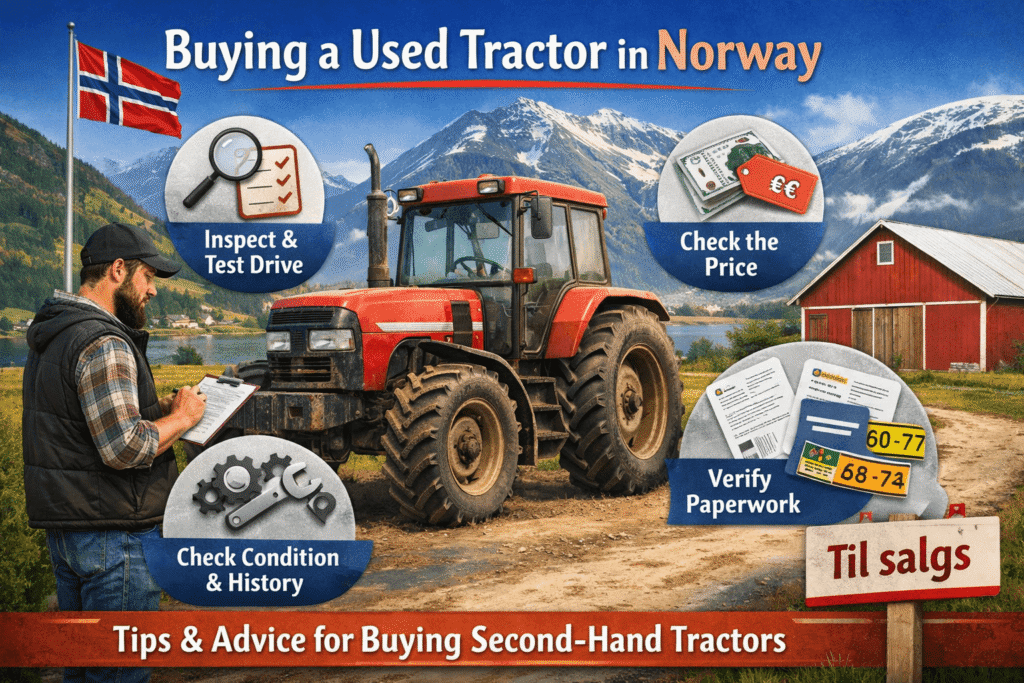
Quick Checklist: What to Check Before Buying a Used Tractor in Norway
- ✅ Cold start test — engine must be completely cold on arrival
- ✅ Exhaust smoke colour — blue, black, or persistent white are red flags
- ✅ All gear ranges tested under load — including on a slope
- ✅ Hydraulics and three-point linkage — check for drift and leaks
- ✅ PTO engagement and safety guard
- ✅ Tyres — tread depth and sidewall frost cracking
- ✅ Cab heating, lights, and water ingress
- ✅ Full service history — dealer-stamped, no gaps
- ✅ Test drive on sloped Norwegian terrain
- ✅ Written confirmation of no outstanding finance
A large proportion of used tractors for sale in Norway are imported from Denmark, the Netherlands, and Germany — where large farms regularly trade in well-maintained machines. This can offer excellent value, but it changes what you need to check:
- Service records in Danish, Dutch or German — always ask for a translated summary before buying
- Parts and warranty managed through foreign dealers — confirm Norwegian dealer support before committing
- No Norwegian cold-climate operating history — test cold-start performance especially carefully
- Outstanding finance from a foreign bank — always request written confirmation of no liens
- Different emissions spec — verify the machine meets Norwegian road and field use requirements
According to Felleskjøpet Agri, Norway’s largest agricultural cooperative and dealer network, a pre-purchase inspection by a qualified technician is especially recommended on imported machines — and typically costs just 1,500–3,000 NOK.
Before You Go — Preparation
The biggest mistakes happen before the inspection starts. Go prepared.
- Research the model’s known faults — every model has weak points. Look up forums, dealer service bulletins, and owner groups for the specific make and year before you travel
- Ask key questions in advance — hours, major repairs, winter storage history, service records. Sellers who can’t answer clearly are a yellow flag
- Check current market prices — browse used farm tractors in Norway to understand what the same model, year, and horsepower currently lists for
- Bring a torch, gloves, and overalls — Norwegian mud, snow, and grime hide leaks, rust, and damage in places invisible without a strong torch
- Consider a Felleskjøpet Agri pre-inspection — their technicians can carry out pre-purchase inspections across Norway for typically 1,500–3,000 NOK — minimal compared to the cost of a hidden gearbox fault
Always view a used tractor in Norway in daylight and dry conditions. Never buy from a cold-weather listing photo alone.
1. Engine and Exhaust — The Most Critical Check
Engine overhauls on a mid-range farm tractor in Norway cost 50,000–180,000 NOK. This section is non-negotiable.
- Cold start test — non-negotiable. Insist the engine is stone cold when you arrive. A warm engine masks smoking, hard starting, and many other problems — especially revealing in Norwegian winter temperatures
- Exhaust smoke colour — blue = burning oil; black = fuel or injection fault; white that persists beyond warmup = head gasket issues. Brief white smoke on a cold Norwegian morning is normal — sustained white smoke is not
- Unusual noises — knocking or rattling on startup indicates bearing or valve train problems. Any noise needs an explanation
- Oil condition — pull the dipstick. Milky or foamy oil indicates coolant contamination — a serious fault
- Leaks underneath — get under with a torch and look for fresh oil staining around the sump, gearbox, and rear axle
- Hour meter vs wear — compare displayed hours against pedal rubber, seat fabric, and cab control wear. A particular risk on imported brukt traktor Norge machines where original ownership history is harder to verify
2. Transmission and Gearbox
Gearbox rebuilds in Norway cost 70,000–140,000 NOK. Test every gear range under load — don’t skip this.
- Test all gear ranges including reverse — every range must engage cleanly. CVT transmissions (common on Valtra, Fendt, and John Deere) should shift seamlessly with no jerking
- Check for slipping on a slope — Norway’s terrain is perfect for this test. Drive uphill in a loaded gear. A transmission that slips on a gradient needs immediate overhaul
- Test diff-lock and 4WD engagement — both must engage and release cleanly at low speed. A faulty 4WD is a deal-breaker for most Norwegian farms
- Check transmission oil — dark, burnt-smelling, or milky oil signals neglected maintenance or water ingress, particularly on machines stored outdoors in Norwegian winters
3. Hydraulics and Three-Point Linkage
- Raise and lower the linkage fully — it should hold position without drifting. A hitch that drops slowly under load indicates worn seals or a failing pump
- Inspect all hoses and rams — Norwegian winters cause hydraulic hoses to crack and harden. Every line and connection needs checking. Hydraulic pump replacement in Norway costs 18,000–50,000 NOK
- Test front loader if fitted — raise, lower, curl, and dump through full range. Check for cylinder drift at full height and inspect all pins for wear — front loaders take heavy daily use on Norwegian farms
4. PTO
- Engage and disengage under no load — juddering or difficulty engaging indicates clutch wear, common on heavily used Norwegian farm machines
- Test both 540 and 1000 rpm settings if present
- Inspect PTO shaft and safety guard — a missing guard is a safety hazard and a sign of careless ownership
5. Tyres, Wheels and Axles
New rear tyres for a mid-to-large tractor in Norway cost 20,000–60,000 NOK per pair — one of the largest single repair costs on any used machine. Never overlook this.
- Rear tread depth — worn lugs dramatically reduce traction on Norway’s wet, steep, and muddy fields. Poor tread on a hillside machine is a functional problem, not just cosmetic
- Sidewall cracking — Norway-specific risk — frost and UV exposure cause severe sidewall cracking on machines stored outdoors. Cracked sidewalls mean replacement regardless of tread depth
- Front axle play — grip each front wheel at 3 and 9 o’clock and rock it. Any play indicates worn king pins or wheel bearings — particularly important on 4WD machines doing hillside work
- Rim corrosion — Norway’s road salt and wet conditions accelerate rim rust. Cracked or heavily corroded rims cause bead sealing problems
6. Cab, Controls and Electrical Systems
- Dashboard warning lights — any lights that remain after the ignition cycle need explanation. CANBUS diagnostics at Norwegian dealer rates are expensive
- Cab heating — Norwegian priority — a working heater is not optional here. Test that it reaches full temperature quickly and all fan speeds work
- Water ingress — freeze-thaw cycles make water ingress extremely common on older Norwegian tractors. Look for staining on the headliner, mould, and rust at cab pillar bases
- All lights and wipers — short dark Norwegian winter days make lighting faults a genuine safety issue, not just an inconvenience
7. Frame and Chassis
- Weld repairs or fresh paint patches — can indicate collision damage or overloading. A repaired main chassis is typically uneconomical to fix — particularly on machines intended for Norway’s steep terrain
- Rust — Norway-specific risk — road salt, snow, and prolonged moisture accelerate rust severely. Check under the bonnet, around the battery tray, chassis rails, and cab pillar bases
- ROPS integrity — the roll-over protection structure must be intact and straight. On Norway’s hillside farms this is critical. A bent or repaired ROPS is reason to walk away — confirmed by Arbeidstilsynet (Norwegian Labour Inspection Authority) safety requirements for agricultural equipment
🚨 Walk away immediately if: the seller refuses a cold start test, can’t produce service records, won’t let you inspect underneath, or dismisses your questions. These are reliable signals of something to hide.
8. Service Records and Documentation
Documentation is as important as the physical inspection when buying a used tractor in Norway. A machine with a complete Scandinavian dealer service history is worth significantly more than an identical tractor with missing records.
- Full service history — ideally Felleskjøpet Agri or brand dealer stamped. Large gaps are a yellow flag; no records at all is a red flag
- Language of records on imported machines — if records are in Danish, Dutch, or German, insist on a translated summary or have a bilingual mechanic review them. Foreign-language records you can’t verify are a significant risk
- Major repair invoices — ask for receipts for engine rebuilds, new tyres, hydraulic work. These confirm the work was done and done properly
- No outstanding finance — in Norway, tractors can be sold with undisclosed debt. Always request written confirmation before signing anything
- Proof of ownership — confirm the seller’s identity matches the documentation
The LRF (Lantbrukarnas Riksförbund) and equivalent Norwegian farming bodies provide useful guidance on private machinery transactions and buyer rights in Scandinavia — worth reviewing if you’re buying privately.
9. The Test Drive — Never Skip It
Never finalise buying a used tractor in Norway without a proper test drive. Even 15 minutes on varied Norwegian ground reveals far more than any static inspection.
- Drive on sloped ground — use Norway’s terrain — hillside conditions are perfect for testing 4WD engagement, transmission under load, and brake effectiveness on gradients
- Test steering to full lock both directions — should be light and responsive with no play. Heavy steering on a hillside machine is a safety concern
- Apply brakes firmly in both directions — must stop straight and evenly. Test individual pedals as well as both together
- After the test drive, park on clean ground and idle for 5 minutes — move the machine and check where it stood. Any fluid drips on clean ground are immediately visible
If buying in winter, request a test drive in actual Norwegian winter conditions. A machine that handles ice and snow well has been properly maintained for the climate.
👉 Browse inspected used tractors for sale in Norway →
10. Typical Repair Costs in Norway (NOK) — 2026
Use this table when negotiating. If an inspection reveals worn tyres, a needed DPF service, and hydraulic hose issues, that’s potentially 60,000–120,000 NOK of upcoming costs — which should be reflected in your offer.
| Repair / Service | Estimated Cost (NOK) | Severity |
|---|---|---|
| New rear tyres (per pair) | 20,000 – 60,000 | High |
| Engine overhaul (mid-range) | 50,000 – 180,000 | Very High |
| Gearbox / transmission rebuild | 70,000 – 140,000 | Very High |
| Hydraulic pump replacement | 18,000 – 50,000 | High |
| DPF / SCR emissions service | 10,000 – 30,000 | High |
| Front axle king pin replacement | 6,000 – 18,000 | Medium |
| Hydraulic hose replacement (set) | 4,000 – 10,000 | Low–Medium |
| Cab water ingress repair | 6,000 – 25,000 | Medium |
| Full service (major interval) | 5,000 – 12,000 | Routine |
Always get dealer quotes for any identified faults before making an offer. Knowing the numbers puts you in a significantly stronger negotiating position.
Estimated Negotiation Impact — Common Faults in NOK
Found a fault during inspection? Use these figures to calculate a realistic reduction from the asking price. Always get a dealer quote before making any specific offer — but these ranges give you a credible starting point at the negotiating table.
| Fault Found | Estimated Price Reduction (NOK) | Notes |
|---|---|---|
| Worn rear tyres (pair) | −20,000 to −60,000 | Get a quote from a local dealer before offering |
| Hydraulic leaks (hoses/seals) | −10,000 to −30,000 | Depends on severity — minor seeps vs active leaks |
| DPF/SCR service overdue | −10,000 to −30,000 | Common on post-2014 machines — check warning lights |
| Cab water ingress | −6,000 to −25,000 | Factor in electronics risk as well as physical repair |
| Front axle wear / king pins | −6,000 to −18,000 | Worse on 4WD hillside machines — a common Norway fault |
| Missing or incomplete service history | −15,000 to −50,000+ | Unknown risk — price accordingly or walk away |
| Transmission slipping under load | −70,000 to −140,000 | Rebuild territory — only buy if price reflects the cost |
Private Sale vs Dealer-Inspected Tractor in Norway
Not sure whether to buy privately or through a dealer? This comparison covers the key differences — especially relevant when buying used farm machinery in Norway where repair costs are high and dealer networks matter.
| Factor | Private Sale | Dealer-Inspected |
|---|---|---|
| Purchase Price | Lower upfront | Slightly higher |
| Risk Level | High — buyer carries full risk | Low — pre-checked before sale |
| Warranty | None | Usually included |
| Inspection | Buyer’s responsibility | Pre-checked by technician |
| Service History | Variable — may be incomplete | Verified before listing |
| Outstanding Finance Risk | Present — must verify | Cleared before sale |
| Best For | Experienced buyers with mechanic access | First-time buyers, remote Norwegian locations |
In our experience, buyers in remote Norwegian regions — Vestland, Trøndelag, Nordland — benefit most from dealer-inspected machines. When the nearest service technician is 200 km away, buying a pre-checked tractor with warranty coverage is significantly lower risk than saving a few thousand NOK on a private sale.
If you’re still deciding between new and used, see our complete guide to buying a used tractor in Norway — new vs used comparison before committing.
👉 Browse pre-inspected used farm tractors in Norway — ready for delivery →
👉 Request a pre-inspected tractor with full service history →
Frequently Asked Questions: Buying a Used Tractor in Norway
What should I check when buying a used tractor in Norway?
The most important checks are: cold start engine test, exhaust smoke colour, transmission across all gears, hydraulics and three-point linkage, PTO operation, tyre condition, cab heating and electrics, frame and chassis, and a full review of service documentation. Always test drive on varied ground — preferably sloped Norwegian terrain.
How many hours is too many on a used tractor in Norway?
Under 5,000 hours is low-to-medium use for a mid-range farm tractor. Machines with 6,000–10,000 hours can still offer good value if service records are complete. Above 10,000 hours, the price should reflect significantly reduced component life. Always cross-check hours against visible wear on seat, pedals, and controls.
Should I get a pre-purchase inspection when buying a used tractor in Norway?
Yes — always. A Felleskjøpet Agri technician or independent mechanic inspection typically costs 1,500–3,000 NOK and uncovers faults invisible to the untrained eye. It’s the single best investment before any used tractor purchase in Norway.
What documents should I ask for?
Full service history, original repair invoices, proof of ownership, and written confirmation that there’s no outstanding finance on the machine. Missing documentation should reduce the price significantly — or be reason to walk away entirely.
Should I buy an imported tractor in Norway?
Imported tractors from Denmark, the Netherlands, and Germany can offer excellent value — these countries have large-scale farms that regularly trade in well-maintained machines. Always verify Norwegian dealer serviceability, parts availability, readable service records, and that any foreign finance has been cleared. A Felleskjøpet Agri pre-inspection is especially recommended on imported machines.
Which used tractor brands are best for Norwegian terrain?
Valtra and John Deere are the most reliable choices for Norwegian conditions — both offer excellent 4WD systems, cold-start reliability, and strong dealer coverage through Felleskjøpet Agri. Valtra is particularly popular for steep hillside and mountain farm work. Massey Ferguson and Fendt are also well-supported across Norway.
What are typical repair costs for a used tractor in Norway?
Norway’s labour rates are among the highest in Europe. Engine overhaul: 50,000–180,000 NOK. Gearbox rebuild: 70,000–140,000 NOK. New rear tyres (pair): 20,000–60,000 NOK. Hydraulic pump: 18,000–50,000 NOK. Always factor these into any offer based on identified faults.