The compact tractor vs sub-compact decision is the most common first question for new tractor buyers — and getting it wrong costs more than money. An undersized machine leaves you constantly at the limit; an oversized one won’t fit through your gates, damages turf, and costs more to buy, run, and store than you ever needed to spend. This guide gives you the honest framework: what separates the two classes, which is right for your property size, the best brands by reliability, whether a skid steer might actually be the better answer, and every PAA question buyers search before making this decision.
👉 Browse compact and sub-compact tractors — all brands, worldwide shipping →
Written by: Farmers Equipment editorial team. Updated August 2026. For independent specifications across all compact tractor brands see TractorData.com. 3-point hitch and PTO standards are set by the American Society of Agricultural and Biological Engineers (ASABE).
Compact Tractor vs Sub-Compact — The Key Differences
| Factor | Sub-Compact Tractor | Compact Tractor |
|---|---|---|
| Horsepower | 18–25 HP | 25–60 HP |
| Weight | 1,200–1,800 lbs | 1,800–4,000 lbs |
| Width | Typically under 60 inches | Typically 60–72 inches |
| 3-point hitch | Category 1 | Category 1 or 2 |
| PTO horsepower | ~15–20 HP | ~20–50 HP |
| Loader lift capacity | ~600–1,100 lbs | ~1,200–2,500+ lbs |
| Price (new) | ~$18,000–$30,000 | ~$28,000–$55,000+ |
| Fuel consumption | ~0.6–0.9 gallons/hour | ~1.2–2.0 gallons/hour |
| Storage | Standard garage — fits easily | Equipment shed typically required |
| Gate width needed | Standard gates — most properties | Wider gates often required |
Which Size Do You Need? — Property Size Guide
| Property Size | Recommended Class | HP Range | Reasoning |
|---|---|---|---|
| Under 2 acres | Sub-compact | 18–25 HP | Mowing, light loader, garden — sub-compact is the right tool, don’t overbuy |
| 2–5 acres (mixed tasks) | Sub-compact to compact | 25–35 HP | Sweet spot — either class works; task intensity determines which |
| 5–20 acres (small farm) | Compact | 35–55 HP | Sustained implement work, larger rotary cutter, more loader capacity needed |
| 20–50 acres | Compact to utility | 50–75 HP | Compact tractor is at the upper end — utility tractor may serve better |
| 50+ acres | Utility tractor | 75 HP+ | Compact tractor is genuinely underpowered at this scale |
How Big of a Compact Tractor Do You Need for 5 Acres?
For 5 acres with a mix of mowing, loader work, and occasional implement use — a 35–45 HP compact tractor is the appropriate size. A sub-compact (18–25 HP) handles 5 acres of mowing but will struggle with a 5 ft rotary cutter in dense growth and will limit loader capacity. A 35–45 HP compact runs a 5 ft rotary cutter comfortably, provides adequate loader capacity for soil, gravel, and material handling, and accepts a wider range of 3-point implements without straining. Don’t buy more than 45 HP for a 5-acre property unless heavy sustained fieldwork is planned.
Are Sub-Compact Tractors Worth It?
Yes — for the right buyer. The case for a sub-compact:
- Lower purchase price — $5,000–$10,000 less than a comparable compact at most brands
- Lower fuel consumption — 0.6–0.9 vs 1.2–2.0 gallons/hour is a real annual cost difference
- Fits standard gates and garages — eliminates the infrastructure cost of wider access
- Easier to operate — lighter controls, more intuitive for first-time owners
- The Kioti CS2530 specifically offers class-leading torque (51.63 lb-ft) and a factory climate-controlled cab as standard — capability that closes the gap with compact tractors more than most buyers realise
The case against a sub-compact:
- PTO-limited — can’t run implements that require 30+ HP PTO
- Loader capacity is lower than compact class — buyer who regularly moves heavy material will feel the limit
- Not the right tool for 5+ acres of brush cutting in dense conditions
- Resale market is smaller than compact class on some brands
If your property is under 5 acres and your work is mowing, occasional loader use, post holes, and light grading — a sub-compact is not a compromise. It is the correctly-sized machine. Buying a compact for a 2-acre property is like buying a full-size pickup to drive 3 miles to work.
What Are the Downsides of Compact Tractors?
| Downside | Details | When It Matters |
|---|---|---|
| Higher purchase price | $28,000–$55,000 new vs $18,000–$30,000 for sub-compact | Always — budget impact from day one |
| Higher fuel consumption | 1.2–2.0 gallons/hour at standard workloads | High-hour users — significant annual cost difference |
| Gate and storage constraints | 60–72 inch width requires wider gates and larger storage | Older properties, narrow lanes, standard garages |
| Turf damage | Heavier weight causes more ground compaction and turf damage | Finished lawns, soft soil, wet conditions |
| Over-complexity for light use | A 50 HP compact on a 2-acre lawn is overkill — higher cost without proportional benefit | Light-use buyers who don’t need the capability |
| Higher maintenance cost | Larger engine, more hydraulic capacity — higher service bills | Annual cost consideration over ownership period |
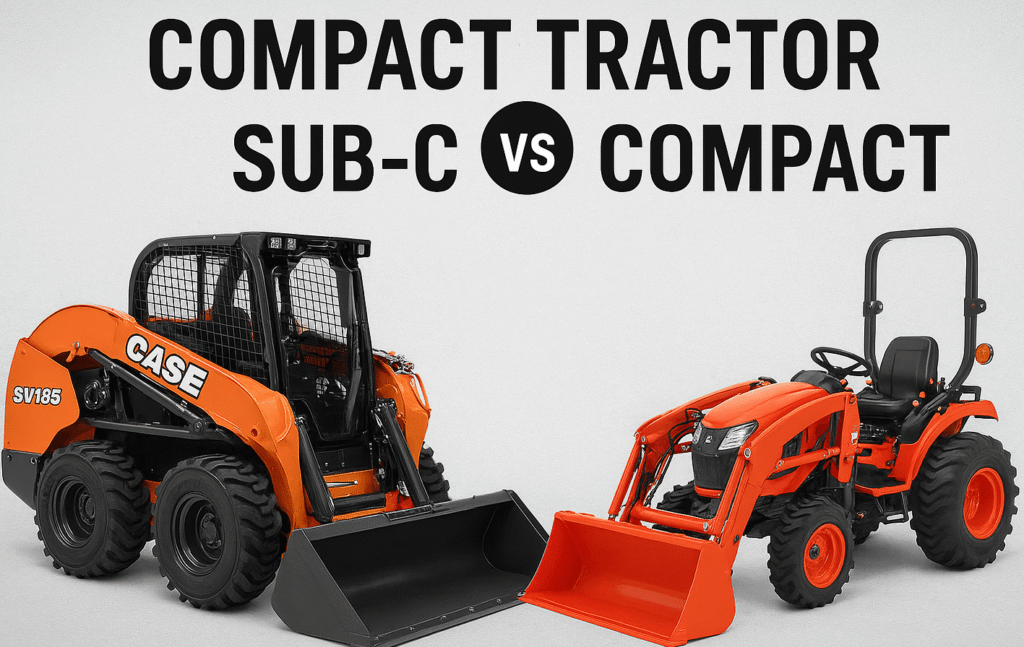
Is It Better to Have a Skid Steer or a Tractor?
This is one of the most searched questions alongside the compact vs sub-compact decision — and the answer is clear once you define what you actually need:
| Factor | Tractor (compact or sub-compact) | Skid Steer |
|---|---|---|
| PTO implements | ✅ Yes — mowers, tillers, post holes, spreaders | ❌ No PTO |
| Loader work | ✅ Good — integral front loader | ✅ Excellent — higher capacity and lift height |
| Mowing | ✅ Excellent — mid-mount, rear, or front mower | ❌ Not designed for mowing |
| Confined space operation | ⚠️ Limited — turning radius larger | ✅ Excellent — zero-turn capability |
| Rough terrain | ✅ Good — 4WD with MFWD | ✅ Good — skid steering handles rough ground |
| Soft ground / turf | ✅ Good — tyres spread weight | ⚠️ Skids damage turf — tracks version mitigates |
| Road travel | ✅ Road-capable | ⚠️ Not road-legal — trailer required |
| Attachment versatility | ✅ Broad — any 3-point or PTO implement | ✅ Broad — skid steer quick-attach ecosystem |
| Snow removal | ✅ Good — blade or blower | ✅ Good — pusher or bucket |
| Price range | $18,000–$55,000 new | $15,000–$60,000+ new |
| Best single-machine answer for mixed farm tasks | ✅ Better — PTO is the tractor’s unique advantage | ❌ No PTO limits what it can do |
| Best for construction-heavy use | ⚠️ Adequate | ✅ Better — built for sustained heavy material work |
What Can a Tractor Do That a Skid Steer Can’t?
The tractor’s unique capability is the PTO (power take-off) — a rotating shaft that drives implements. A skid steer has no PTO. This means a tractor can power rotary cutters, tillers, post hole diggers, hay balers, spreaders, seed drills, and dozens of other implements that a skid steer simply cannot run. For farmers and rural property owners who need to mow, till, dig, and haul — the tractor is the more versatile machine. For buyers whose primary work is moving material and loading — the skid steer’s higher loader capacity and zero-turn manoeuvrability can be advantageous.
What Are the Disadvantages of a Skid Steer?
- No PTO — can’t run any PTO-driven implements (mowers, tillers, balers)
- Not road-legal — requires a trailer to move between sites
- Damages turf — skid steering tears grass and soil in turns. Compact track loaders (CTLs) mitigate this
- Higher operator fatigue — cab is more confined and the skidding action is physically demanding over long periods
- No 3-point hitch — limits implement compatibility to dedicated skid steer attachments
Do Skid Steers Flip Over?
Skid steers can tip if operated incorrectly — most commonly when driving with the loader raised, turning sharply on slopes, or carrying unbalanced loads. Modern skid steers have ROPS (Roll-Over Protective Structures) as standard, which protects the operator if a tip occurs. When operated correctly — loader lowered during travel, working across slopes rather than up/down, load within rated capacity — skid steers are stable machines. The tipping risk is real but manageable with correct operator practice. Tractors have a similar risk on steep slopes; neither machine should be driven with a raised load on uneven terrain.
Browse our skid steer loaders for sale →
Most Reliable Sub-Compact and Compact Tractor Brands
Is Kubota or John Deere Better?
| Factor | Kubota | John Deere |
|---|---|---|
| Reliability | ✅ Benchmark in compact class | ✅ Excellent — consistent across all sizes |
| Dealer network | Strong — ~1,600+ US dealers | Largest — most comprehensive US network |
| Parts availability | Excellent — next-day most markets | Excellent — next-day most markets |
| Resale value | Strong — 60–75% after 5 years | Very strong — 65–75% after 5 years |
| Technology | Good — Kubota Advanced system | Better — Operations Center ecosystem |
| Sub-compact best model | BX23S (21.6 HP) | 1025R (23.9 HP) |
| Compact best model | L3301 / L3901 (33–37 HP) | 5E Series (45–75 HP) |
| Price vs equivalent | Competitive — roughly equal | Premium — 5–15% above Kubota |
| Verdict | Benchmark reliability — best in compact class | Best dealer network and technology |
The honest answer: both are excellent. In direct owner surveys, Kubota edges John Deere on reliability per operating hour in the compact and sub-compact class. John Deere edges Kubota on dealer network density, technology integration, and long-term resale. For most buyers, the decision comes down to which dealer is closer and stronger, not which brand is objectively better.
What Is the Most Reliable Sub-Compact Tractor?
By owner-reported reliability: Kubota BX Series is most consistently cited as the most reliable sub-compact tractor — proven design, strong parts availability, and the longest established track record in the class. John Deere 1025R is a close second. The Kioti CS2530 has strong reliability reports and class-leading torque, with the caveat that dealer support is less consistent than Kubota or JD in some markets. The most reliable sub-compact is ultimately a well-maintained machine from any major brand — maintenance history predicts reliability more accurately than brand name.
Are Mahindra Tractors as Good as John Deere?
In machine reliability and capability — competitive. Mahindra is the world’s largest tractor manufacturer by unit volume and produces well-regarded machines in the 20–60 HP range. The key difference is support infrastructure: John Deere’s dealer network is vastly more comprehensive than Mahindra’s in North America — better parts availability, faster service, and more experienced technicians. For a buyer with a strong local Mahindra dealer, the machine itself is competitive. For a buyer in an area with no Mahindra dealer presence, John Deere’s support infrastructure advantage is a real practical consideration. Mahindra’s pricing is typically 15–25% lower than John Deere on equivalent specifications — a real budget advantage when dealer access is not a concern.
What Tractor Brand Has the Least Problems?
In the sub-compact and compact class: Kubota consistently ranks lowest for reported problems per operating hour in independent owner surveys. John Deere is very close second. Both brands have comprehensive parts availability that means problems — when they occur — are resolved faster than on brands with thinner dealer networks. The brand with fewest problems is also the best-maintained machine from any major manufacturer — neglected Kubota tractors fail just as reliably as neglected machines from any other brand.
How Many Hours Is Too Many for a Compact Tractor?
| Hours | Assessment | What to Check |
|---|---|---|
| Under 500 hours | Low — essentially new | Standard pre-purchase inspection |
| 500–1,500 hours | Low-to-mid — good used buy with history | Fluid condition, hydraulic seals, loader pivot pins |
| 1,500–3,000 hours | Mid — solid if maintained | Transmission test, hydraulic pressure, all seals |
| 3,000–5,000 hours | Mid-to-high — viable with history | Engine compression, HST performance, all wear items |
| 5,000+ hours | High — value should reflect it | Full inspection — budget for near-term maintenance |
There is no absolute “too many hours” threshold — the question is always maintenance history vs hours. A 4,000-hour Kubota L Series with complete dealer service records is a better purchase than a 1,500-hour machine with no paperwork. Hours without history tell you very little. Hours with documented maintenance tell you almost everything.
Will Tractor Prices Go Down in 2026?
New tractor prices: unlikely to fall significantly. Stage V emissions compliance costs, input cost pressure on steel and electronics, and stable dealer demand mean new compact and sub-compact prices are holding flat in 2026. The best route to new tractor price concessions remains November–December dealer year-end deals and manufacturer promotional finance offers.
Used tractor prices: have softened 5–10% from the 2022–2023 peaks as supply has recovered. In August 2026 the used compact tractor market is reasonably well-supplied — particularly in the 3–6 year bracket where post-harvest farm trade-ins are coming to market. Compact tractors in the 35–55 HP range with good service history are currently available at prices meaningfully below their 2023 peaks. This is a reasonable buying window for used compact and sub-compact tractors.
Best Sub-Compact and Compact Tractors — 2026 Recommendations
| Buyer Profile | Best Choice | Why |
|---|---|---|
| Best overall sub-compact | Kubota BX23S | Strongest reliability + factory TLB + best parts support |
| Best sub-compact with factory cab | Kioti CS2530 | Only sub-compact with factory climate-controlled cab standard |
| Best sub-compact technology | John Deere 1025R | JDLink, AutoConnect mower, best technology ecosystem |
| Best value sub-compact | Mahindra eMax 25L or Branson | 10–20% below Kubota/JD for comparable capability |
| Best compact (30–40 HP) | Kubota L3301 / L3901 | Most proven compact tractor in North America |
| Best compact for technology | John Deere 5E Series | Operations Center + strongest dealer network |
| Best compact value | Massey Ferguson 4700 Series | Good mid-market machine below Kubota/JD pricing |
Browse: Kubota tractors · John Deere tractors · Sub-compact tractors · Massey Ferguson tractors →
For sub-compact TLB comparison see our sub-compact tractor with backhoe guide and compact tractor with loader buyer guide →
👉 Contact us to discuss the right size and brand for your property →
Frequently Asked Questions
Which is better — compact tractor or sub-compact?
For properties under 5 acres with light-to-moderate work: sub-compact. For 5–20 acres with sustained implement use and heavier loader work: compact. The sub-compact is not a compromise for the right buyer — it is the correctly-sized machine for light-to-moderate rural property work. Buying a compact for a 2-acre property is overbying without proportional benefit.
Are sub-compact tractors worth it?
Yes — for buyers whose property and workload match the class. Lower purchase price, lower fuel consumption, standard gate clearance, easier operation, and modern sub-compacts like the Kioti CS2530 (51.63 lb-ft torque, factory cab) deliver capability that narrows the gap with compact tractors significantly. The answer is no only if you consistently exceed the HP, PTO, or loader capacity limits — in which case a compact is the right tool.
Is it better to have a skid steer or a tractor?
For mixed farm and rural property tasks — the tractor, because the PTO is unique to tractors. No skid steer can run a rotary cutter, tiller, post hole digger, or baler. For pure material moving and loading in confined spaces — a skid steer’s higher loader capacity and zero-turn manoeuvrability can be advantageous. Most rural property owners are better served by a compact tractor with loader than a skid steer.
Which is better — John Deere or Kubota sub-compact?
Both are excellent — the practical choice is which dealer is stronger in your area. Kubota edges John Deere on reliability per hour in owner surveys. John Deere edges Kubota on technology (Operations Center, AutoConnect mower) and long-term resale. For most buyers the dealer relationship and local support quality matters more than the brand distinction.
What is the most reliable sub-compact tractor?
Kubota BX Series — most consistently cited for lowest problems per operating hour in owner surveys, strongest parts availability, most proven design in the class. John Deere 1025R is a very close second. Kioti CS2530 has strong reliability reports with the caveat of variable dealer support in some markets. The most reliable sub-compact is any well-maintained machine from a major brand — maintenance predicts reliability more than brand name.
Are Mahindra tractors as good as John Deere?
In machine quality and capability — competitive. Mahindra is the world’s largest tractor manufacturer by unit volume with well-regarded machines. The key gap is support infrastructure: John Deere’s dealer network is vastly more comprehensive in North America. For buyers with a strong local Mahindra dealer, the machine competes well at 15–25% lower pricing. For buyers without local Mahindra support, John Deere’s infrastructure advantage is a practical consideration.
How many hours is too many for a compact tractor?
There is no absolute threshold — the question is always hours vs maintenance history. A 4,000-hour Kubota L Series with complete documented service records is a better purchase than a 1,500-hour machine with no paperwork. As a rough guide: under 1,500 hours is low-to-mid; 3,000–5,000 hours is high but viable with strong history; above 5,000 hours, price should reflect remaining useful life significantly.
Will tractor prices go down in 2026?
New prices: unlikely. Used prices: have softened 5–10% from 2022–2023 peaks. August 2026 is a reasonable buying window for used compact tractors — supply is good in the 3–6 year bracket and prices are below their recent peak. New tractor deals are best in November–December at dealer year-end.